
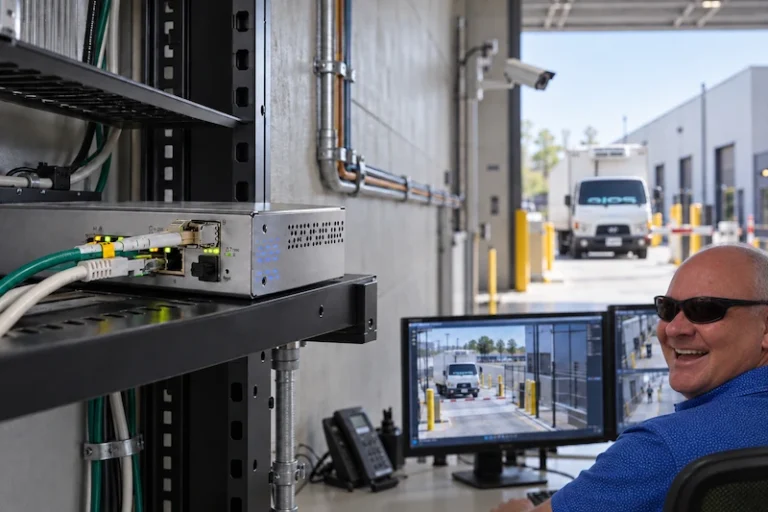
In today’s digital age, a fast and reliable internet connection is crucial for both businesses and individuals. Ethernet technology has long been a staple for wired networking, but what do you do when your network needs to cover larger distances? This is where Ethernet extenders come into play. In this article, we’ll explore what Ethernet extenders are, how they work, and whether you really need them. Let’s dive in!

The modern world runs on data, and the internet plays a key role in most business operations. However, before any business can even attempt to utilize the internet, it’s important to establish and secure your local network.
This is where the Ethernet and Ethernet Extenders come in. By connecting your computer systems and forming a local area network (LAN), you can promote seamless communication between all the devices your business uses. However, Ethernet cables do more than simply connect different computers to each other: they’re also essential for connecting to the internet.
Over the years, Ethernet technology has progressed to allow more reliable data transfer. However, there are still limitations in the technology: in the late 1980s, when Twisted pair wiring became the cable standard, manufacturers discovered that wiring beyond a certain length resulted in data loss. Since then, Ethernet device manufacturers have limited installable Ethernet distance limits to 100 meters. What happens when your needs exceed those?
Enter The Ethernet Extenders
Ethernet extenders – also called “network extenders” or “LAN extenders” – are devices used to extend the Ethernet or network beyond its inherent limit of 100 meters. Today’s Ethernet extenders make use of interactive high speed routing so that complex signal-path groupings across circuit boards can be tuned for high-speed technology. Using both rigid and flex circuits, designers are able to create Ethernet extenders that can support the need for high-speed data transmission across long distances. Since most advanced devices also use lower signal levels, the accompanying high speed routing guidelines are designed to prevent signal loss, distortion, and interference.
There are several types of Ethernet extenders. Some Ethernet extenders work by using unconditioned copper wiring – those without load coils – and use various encodings to transmit information between cables. However, the most used technology is currently discrete multitone modulation (DMT), which have bit rates ranging from about 26 MBit/s for loops of about 1,500 meters. Shorter loops of about a few hundred meters can carry up to 100 MBit/s. With such robust transmission rates, Ethernet extenders have made HDTV and VoIP services more accessible with less chances of reflections from impedance continuities.

How Do Ethernet Extenders Work?
Ethernet extenders work by utilizing existing copper cabling infrastructure, such as telephone lines or coaxial cables, to transmit Ethernet signals over longer distances. Here’s a simplified step-by-step explanation of how they work:
- Signal Conversion: Ethernet extenders take the Ethernet data from your network and convert it into a suitable format for transmission over copper cables.
- Amplification: The signal is then amplified to overcome the attenuation (signal loss) that occurs as the signal travels over long distances.
- Decoding: At the receiving end, another Ethernet extender decodes the signal back into standard Ethernet data, allowing it to be used by devices connected to the extended network.
Do You Need an Ethernet Extender?
A majority of Enable-IT’s installations are done for workspaces that have uncontrolled outdoor conditions, exposed environments, or potentially harsh conditions. Customers include the military, NASA, aerospace manufacturers, video surveillance and security specialists, telecommunications companies, and broadcasting and news agencies – to name a few. Many businesses serve to benefit from secure Ethernet solutions.
Small businesses may think that an Ethernet extender is unnecessary, as most office networks will not go beyond the 100-meter limit of Twisted pair wiring. However, if your operations span multiple buildings and you need to invest in secure data transfer within your network, an Ethernet extender could be the ideal solution. After all, even relying on Wi-Fi can be tricky, as signals require clear lines of sight, special receivers, and could be adversely affected by weather conditions.

The need for Ethernet extenders depends on your specific network requirements. Here are some scenarios where Ethernet extenders can be highly beneficial:
- Extending Network Range: If you have a network that needs to cover a large area, such as a campus, factory, or warehouse, Ethernet extenders can help you maintain a stable and high-speed connection throughout.
- Retrofitting Older Infrastructure: Ethernet extenders are a cost-effective solution for upgrading your network infrastructure without the need for extensive rewiring. They can make use of existing copper cabling.
- Overcoming Distance Limitations: When your devices are located far from the central networking equipment, Ethernet extenders can bridge the gap and provide connectivity.
3 Best Steps To Understand Ethernet Extenders
Now that you have a basic understanding of Ethernet extenders, here are three essential steps to better comprehend their functionality and determine if you need them:
- Assess Your Network Needs: Start by evaluating your network requirements. Consider the physical layout of your location and the distance between networking equipment and end-user devices. If you find that your network exceeds the standard Ethernet cable length limitations, Ethernet extenders may be a suitable solution.
- Check Your Existing Infrastructure: Determine what type of existing copper cabling infrastructure you have in place. Ethernet extenders are compatible with various types of copper cables, including Cat 5, Cat 6, telephone lines, and coaxial cables. Understanding your infrastructure will help you choose the right type of extender.
- Consult with Networking Experts: If you’re unsure about the technical aspects or the specific requirements of your network, it’s a good idea to consult with networking professionals or specialists in Ethernet extender technology. They can provide tailored advice and help you choose the right equipment for your needs.
Considerações finais e conclusão
In conclusion, Ethernet Extenders serve as essential resources for extending Ethernet networks over extended distances, particularly in situations where rewiring proves impractical. The necessity for these extenders hinges on factors such as your network’s scale, layout, and current infrastructure. By adhering to the guidelines presented in this article, you can arrive at a well-considered decision and guarantee the ongoing speed and dependability of your network.
Remember that technology is always evolving, and staying informed about the latest advancements in networking can help you make the best choices for your network’s future growth and stability.

Pro longo qualquer cabo Ethernet além dos limites com as soluções Enable-IT !
O benefício de comprar um Extensor Ethernet da Enable-IT é que nosso equipamento aproveita os sinais de telecomunicações de alta capacidade através de qualquer cabo – incluindo cabo coaxial, cerca de arame farpado, etc. Possui distâncias sem precedentes no mercado. Existem Soluções de Extensores Ethernet disponível, que pode ampliar esse limite de distância para 9.000 pés ou 2.743 m.
As aplicações da indústria são infinitas – já que todos necessitam de redes Ethernet por períodos mais longos ao longo da vida útil, e mais cedo ou mais tarde essa necessidade surgirá e estamos prontos para ajudá-lo a selecionar a solução ideal.
Entre os clientes da Diversa Industry estão o Exército dos EUA, do Reino Unido e do Canadá; a NASA; fabricantes de produtos aeroespaciais; Infraestrutura Navais (Marinas, iates de luxo, navios de cruzeiro, instalações portuárias, frota nuclear dos EUA, etc.); Peritos em Vigilância por Vídeo e Segurança; Avançado Empresas de telecomunicações; Mineração extrema Operadores; Global Empresas de construção; Comercial Empresas do setor agrícola; principal Fornecedores de cuidados de saúde; Em direto Entretenimento, Transmissão de televisão, e agências de notícias; Extremas Organizações de varejo/POS; Distância longa Empresas de Educação; Internacional Empresas de hospitalidade; Fabricantes de elevadores, Digital Signage e muito mais.





 English
 Spanish
 Portuguese