
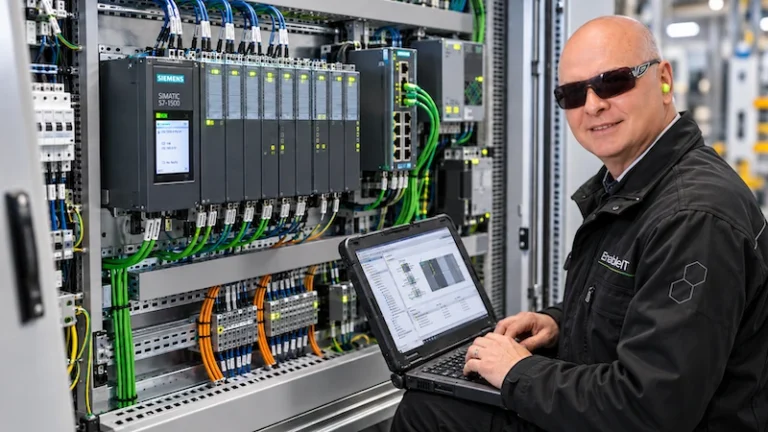
Key Benefits of Extending the reach of Programable Logic Controllers
Real time Decision Making – Manufacturing operations demand precision metrics to stay competitive. Fine-tuned decision points require real time responses, a far cry from the days of manual data collection during rounds. In the past, interpreting handwritten data from printouts, gauges, and chart recorder traces was a laborious process, far from real-time insights. However, the evolution of data acquisition methods has ushered in an era of real-time decision-making capabilities.
- Verification and Data Accuracy.
- Remote Monitoring and Automation.
- Data Integration and Real-Time Adjustments
- Peer-to-Peer Networking
- Audit Trails and Compliance
Meeting the Challenge for Networked PLCs
Industrial Automation today has a need for real time Information and process control. Traditional PLC have been serial hardwired connected for decades and new facilities have been requiring faster response beyond serial communications. Serial controls require hands on maintenance and staff to monitor and maintain. Both from a business and technical reason, the move to LAN connected PLCs has been growing and challenging to get right.

Industrial network configurations
In the intricate realm of PLC automation, networks serve as the lifeblood, connecting devices, facilitating communication, and enabling resource sharing. When we talk about networks in the context of industrial PLC automation, it’s not just a simple local area network (LAN) with PCs and printers. The industrial landscape demands a higher level of sophistication, especially concerning industrial Ethernet, which has become the backbone of modern industrial real time communication systems.
Unlike traditional office LANs, industrial Ethernet must meet stringent criteria, including determinism, data integrity, security, network reliability, and speed tailored for specific applications. Transitioning to industrial Ethernet requires a deep understanding of your existing network, its configuration, and inherent limitations. Identifying the type of industrial network your plant employs is the first step toward optimizing your operations.
PLC networking can be broadly categorized into PLC-to-enterprise and PLC-to-PLC configurations. In PLC-to-enterprise setups, PLCs are linked to systems providing essential data to decision-makers across the enterprise. This data is pulled into interfaces like human-machine interfaces (HMI), supervisory control and data acquisition (SCADA) systems, manufacturing execution systems (MES), or enterprise resource planning (ERP) systems. These configurations enable both read-only and read-write access, empowering the enterprise to visualize processes, make adjustments, manage recipes, and troubleshoot effectively.PLC

Diverse PLC Networking Configurations:
PLCs are the heartbeat of industrial processes, and networking them opens up a realm of possibilities. There’s no one-size-fits-all approach; the diversity in PLC network configurations mirrors the complexity of industrial setups. Leveraging existing infrastructure is key. The challenge lies in effectively utilizing technologies like industrial Ethernet, proprietary fieldbuses, and networked PLCs from multiple vendors. These challenges are surmountable, evident in the fact that many plants have successfully integrated networked PLCs into their operations.
On the other hand, PLC-to-PLC configurations, often within the same LAN or subnet, connect multiple PLCs. This peer-to-peer setup enables seamless data exchange among controllers, optimizing larger processes or groups of machines.
Making Informed Choices: To Network or Not to Network Your PLCs

The decision to network Programmable Logic Controllers (PLCs) is not one size fits all. Several factors come into play, making the choice complex yet crucial for seamless operations. Here are key considerations when contemplating whether or not to network your PLCs:
- Scale and Complexity:
If your system is small-scale, like a standalone machine, or if your need for PLC data is minimal, the cost-effectiveness of networking might be in question. Simple applications with limited peer-to-peer communication requirements might suffice with a direct cable connection between a couple of PLCs. For applications needing fewer signals, limited data volume, or short cable runs, hardwiring could be a viable, cost-effective choice. Beyond certain parameters, the cost of labor and wiring might make networking a more attractive option.
2. Single PLC Setup:
When dealing with a solitary PLC, the decision to network it boils down to data extraction. The cost-effectiveness of this process versus the potential benefits becomes the focal point. Evaluating the return on investment (ROI) becomes crucial. Determining the minimum cost for this operation, specific to your plant, process, machine, and network, is essential in justifying the expense.
The Expert’s Choice
The presence of PLCs from multiple competing manufacturers raises compatibility concerns. Most PLCs operate on proprietary protocols, posing challenges for data integration. Enter OLE for Process Control (OPC), a solution that bridges this gap. OPC allows seamless communication among PLCs and devices from various vendors, regardless of proprietary protocols. This approach facilitates integration, enabling the creation of user-friendly interfaces displaying data from diverse devices, spanning both fieldbus and Ethernet networks.
4. Overcoming Proprietary Challenges with OPC:
OPC serves as a game-changer by enabling data comprehension and usage across PLCs and devices, regardless of manufacturer-specific protocols. Major automation vendors have embraced OPC due to its versatility in industrial Ethernet and fieldbus-based systems. By leveraging OPC, you can link PLCs, control devices, and functions to specific network addresses. This flexibility empowers the creation of intuitive interfaces representing different device functions, fostering a comprehensive understanding of their interrelationships within your manufacturing environment.
In essence, the decision to network PLCs is multifaceted and unique to each industrial setup. Careful consideration of scale, data requirements, and compatibility factors, alongside the potential of technologies like OPC, can guide you toward making informed choices. By evaluating the specific needs of your operation, you can harness the power of networking, ensuring seamless communication and optimal efficiency in your industrial processes.
Solutions Available for Industrial Automation PLCs
At Enable-IT, our engineering team boasts over 40 years of expertise in transitioning serial solutions to Ethernet, particularly in extended Ethernet solutions. We understand the complexities involved in using Ethernet or PoE extenders to bridge the distances prevalent in serial-based PLC units. Most importantly, we comprehend the intricacies of tuning PLCs for specialized Ethernet requirements over extended distances.
Industrial network optimization is not just a technological challenge; it’s an opportunity for innovation. With the right expertise and solutions, the potential of your industrial network can be fully realized. Contact us today to embark on a transformative journey, where challenges become opportunities and complexities turn into streamlined efficiency.
- Enable-IT 860X PRO – Gigabit Full Duplex Single Port Ethernet Extender
- Enable-IT 821 / 821P – 100Mbps Full Duplex Single Port Ethernet / PoE Extender
- Enable-IT 860XS PRO – Gigabit Full Duplex Quad Port Ethernet Extender

Contact our team to understand the benefit of leveraging any of our Ethernet Extender or PoE Extender Technologies. Our equipment leverages high throughput telecom signals over any existing or new wire – including coax, telephone wiring, Cat rated twisted pair, etc. Enabling distances unheard of in the industry. There are Soluções de Extensores Ethernet disponível, que pode ampliar esse limite de distância para 9.000 pés ou 2.743 m.


Pro longo qualquer cabo Ethernet além dos limites com as soluções Enable-IT !
O benefício de comprar um Extensor Ethernet a partir de Enable-IT porque nosso equipamento aproveita os sinais de telecomunicações de alta taxa de transferência através de qualquer cabo – incluindo coaxio, cerca de arame farpado, etc. Possibilita distâncias sem precedentes no mercado. Existem Soluções de Extensores Ethernet disponível, que pode ampliar esse limite de distância para 9.000 pés ou 2.743 m.
As aplicações da indústria são infinitas – já que todos necessitam de redes Ethernet por períodos mais longos ao longo da vida útil, e mais cedo ou mais tarde essa necessidade surgirá e estamos prontos para ajudá-lo a selecionar a solução ideal.
Entre os clientes da Diversa Industry estão o Exército dos EUA, do Reino Unido e do Canadá; a NASA; fabricantes de produtos aeroespaciais; Infraestrutura Navais (Marinas, iates de luxo, navios de cruzeiro, instalações portuárias, frota nuclear dos EUA, etc.); Peritos em Vigilância por Vídeo e Segurança; Avançado Empresas de telecomunicações; Mineração extrema Operadores; Global Empresas de construção; Comercial Empresas do setor agrícola; principal Fornecedores de cuidados de saúde; Em direto Entretenimento, Transmissão de televisão, e agências de notícias; Extremas Organizações de varejo/POS; Distância longa Empresas de Educação; Internacional Empresas de hospitalidade; Fabricantes de elevadores, Digital Signage e muito mais.





 English
 Spanish
 Portuguese