
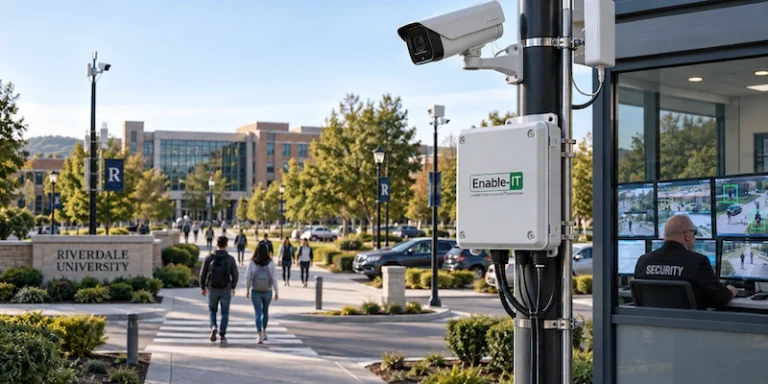
Campus Security: Put Your AI Threat-Recognition Cameras Where You Need Them Most 🎯
In today’s complex campus environments – universities, colleges, polytechnics, school districts – traditional “install-and-forget” video surveillance is no longer enough. Threats evolve, attention spans are limited, and budgets are tight. The smart move is to transform your campus video system into a proactive, AI-powered security apparatus – and to deploy it in the places that matter, leveraging existing infrastructure.
With the right architecture, you don’t need to tear up every corridor or build new conduits everywhere. That’s where Enable-IT PoE extenders shine.

Why AI + Surveillance Is a Game Changer
Let’s first refresh the key shifts in video security, then show how Enable-IT’s technology amplifies them.

From Passive Cameras to Active Monitors
For decades, video cameras on campuses were little more than silent witnesses. They recorded events, but they couldn’t understand them. If an incident happened – a theft, a fight, or worse – security staff had to rewind hours of footage to find the evidence. Useful? Yes. Preventive? Not at all.
Today, thanks to AI-powered analytics, surveillance has undergone a fundamental shift: cameras are no longer passive “eyes on the wall” but active, intelligent monitors that help protect students and staff in real time.
1. Real-Time Detection 🚨
AI enables cameras to recognize suspicious activities as they happen:
- Intrusion detection: Someone entering restricted areas like labs, dormitories, or staff parking lots.
- Loitering alerts: Individuals lingering near entrances, playgrounds, or secluded areas.
- Aggressive behavior: Fighting, running, or sudden abnormal movements detected through motion and posture analysis.
Instead of waiting for a guard to notice something on a wall of monitors, the system automatically flags the event and notifies security staff instantly – reducing response time from minutes to seconds.
2. Predictive Awareness 🔮
Modern AI doesn’t just react; it learns patterns over time.
For example:
- If students usually gather outside the library in the evening, the system learns that’s normal.
- If an unfamiliar person paces back and forth late at night near dorm entrances, the system raises an alert.
This context awareness minimizes false alarms and helps security teams focus on real risks.
3. Integration with Campus Safety Systems 🏫🔗
AI cameras can be integrated into a unified campus safety ecosystem. That means when the camera detects a threat:
- 🔒 Doors can lock automatically in the affected area.
- 💡 Lights can activate in dark zones to deter suspicious behavior.
- 📢 Public address systems can broadcast warnings.
- 🚔 Local law enforcement can be notified automatically.
This creates a coordinated response that goes far beyond just “watching a video feed.”
4. 24/7 Consistency (Unlike Human Monitoring) 👀
Security staff can’t be everywhere, and fatigue sets in after hours of monitoring screens. Studies show that human attention drops significantly after just 20 minutes of watching surveillance feeds. AI, however:
- Never gets tired.
- Monitors every camera simultaneously.
- Flags anomalies 24/7, ensuring no critical moment slips through.
The result is a force multiplier: the same security staff now have a tireless AI “assistant” watching hundreds of feeds at once.
5. Campus Examples 📌
- Dormitories: AI detects when someone tries to “tailgate” behind a student into a secure residence hall.
- Sports arenas: AI picks up sudden crowd surges or aggressive movements that could indicate a fight or emergency.
- Parking lots: AI recognizes abandoned bags or cars lingering too long, alerting staff before it becomes a risk.
- Laboratories: Access violations can be flagged instantly if unauthorized personnel attempt entry.
6. The Bigger Picture 🌍
This shift from passive to active monitoring doesn’t just make campuses safer – it also builds confidence and peace of mind for students, parents, and faculty. Knowing that threats are being actively monitored and responded to in real time creates an environment where learning and community life can thrive.
👉 In short: AI transforms cameras into proactive guardians, not just passive witnesses. When combined with Enable-IT PoE extenders, these smart guardians can be placed anywhere on campus, even in remote zones previously out of reach.

Real-World Performance & Latency
A challenge many fear is latency – i.e. how quickly the system can detect something and alert staff. In one real-world experiment, an AI system operating across 16 cameras in a community college environment achieved ~26.8 seconds of end-to-end latency from event to notification.
That’s a promising benchmark: with good design, AI surveillance can operate reliably in real conditions.

Why Enable-IT PoE Extenders Make This Even Better
You already know that cameras need both data and power (PoE). But real campuses often lack perfect cabling or infrastructure everywhere. This is where Enable-IT’s PoE extenders offer a major edge.
Reach & Flexibility
- Enable-IT devices can push PoE + Ethernet up to 9,000 feet (≈ 1.7 Mi / 2.74 km) over existing wiring.
- For outdoor/extreme environments, options like the 821WP Outdoor PoE Extender Kit extend encrypted, secure PoE over long distances via 1-pair wiring, supporting up to ~3,000 ft (1,000 m) distance in rugged conditions.
- Because they work over telephone wiring, legacy cabling, or new runs, you often avoid costly trenching or new fiber runs.
This means you can deploy AI cameras exactly where you need them – remote corners of campus, athletic fields, satellite buildings – even if the existing network doesn’t reach.
High Performance & Compatibility
- Enable-IT’s extenders support transparent operation of Ethernet and PoE standards, with no need to reconfigure IPs, protocols, or MAC addresses.
- These devices are used in defense, government, video surveillance, aerospace, etc. – implying reliability under mission-critical loads.
- Because they are protocol-transparent, your AI and VMS systems continue “as is” – your analytics, cameras, and software don’t need to know or care about the extender in between.
Cost Efficiency
- Compared to installing new fiber or long runs of fresh Ethernet cable, using extenders over existing wiring saves on labor, infrastructure, and maintenance.
- Lower downtime during upgrade phases, since you don’t need large network rewiring.
- Reduced footprint: fewer new network closets or intermediate switches needed.

Best Use Scenarios on Campus
Here are several high-impact deployment scenarios where AI cameras + Enable-IT extenders truly shine:
| Scenario | Challenges Without Extenders | How AI + Enable-IT Helps |
|---|---|---|
| Isolated outdoor zones (sports fields, parking lots, remote buildings) | Network doesn’t reach; expensive to pull cable/fiber | Use PoE extenders over existing wiring to bring AI cameras to those zones |
| Dormitory perimeters & walkways | High demand, low coverage, blind spots | Continuous real-time behavior detection (tailgating, trespassing, loitering) |
| Aggregated building cluster | Legacy coax or analog cameras; limited bandwidth | Integrate with AI analytics and uplink data over extenders |
| Event & crowd areas (e.g. campus events, concerts) | Temporary camera needs, high density | Deploy temporary AI camera nodes easily with extenders |
| Vehicle entry & parking zones | Need license plate recognition (LPR) | AI + extenders support LPR at remote gates, integrating with access control |
These use cases allow you to focus your investment where risk is highest, rather than blanket coverage everywhere.

Case Studies & Examples
- SMU (Southern Methodist University)
SMU deployed over 100 cameras across its 186-acre campus, wired to 13 Video Insight servers. The university leveraged its existing camera infrastructure while gradually migrating to IP deployment.
They also maintained flexibility: analog and digital cameras could appear in the same monitoring console, easing transition phases.
- Fairfield Community Schools
The Fairfield school district deployed 138 cameras across several campuses, covering entrances, hallways, gyms, playgrounds, parking, etc. Their goals included giving law enforcement secure remote video access and using cloud storage for redundancy.
- University of Warmia and Mazury, Poland
This university installed ~1,000 Hanwha Vision cameras campus-wide to safeguard students, staff, and visitors.

Future Trends & Prospects
Campus security is not standing still. Just as threats evolve, so too does technology – and the next decade will bring smarter, faster, and more integrated surveillance ecosystems. Here are the most important trends shaping the future of AI-powered campus monitoring and how Enable-IT’s PoE extenders make them possible.
1. Edge AI & Smarter Cameras 🧠📷
Right now, much of the heavy AI processing happens on servers. But tomorrow’s cameras will have onboard AI chips capable of analyzing data locally – right at the “edge.”
Benefits:
- ⚡ Lower latency: Alerts are triggered instantly, not after video travels across the network.
- 📉Reduced bandwidth: Only critical data (alerts, metadata) needs to be sent to servers, not full streams.
- 🔐Better privacy: Sensitive footage can stay on-camera, while only anonymized analytics data is shared.
Campus use case: Imagine a camera at a remote athletic field – thanks to Enable-IT PoE extenders, it can be powered and connected over long distances, while its edge AI instantly recognizes unauthorized late-night entry without straining central servers.
2. Federated Learning & Continual Model Updates 🔁
AI models don’t stay static. With federated learning, cameras across different zones or campuses can “learn locally” and share updates securely with a central model – without transferring raw video.
Why it matters for campuses:
- A camera near the library may learn to distinguish normal student gatherings from suspicious loitering.
- Another camera in a dorm may learn to detect tailgating at entrances.
- Together, they continuously improve security without increasing false positives.
3. Convergence of Systems (The Smart Campus Hub) 🏫🔗
The future of security is integration: cameras won’t work in isolation but as part of a unified command ecosystem.
- 🔒 Access control: Cameras linked to smart ID systems can instantly verify if someone entering a lab or dorm belongs there.
- 💡 Smart lighting: AI-triggered lights can discourage intruders or guide students safely during emergencies.
- 📢 Voice announcements: Automated alerts can be broadcast when AI detects an incident.
- 🚔 Direct law enforcement integration: Police can gain secure, real-time access during emergencies.
This holistic system transforms campuses into responsive environments rather than static spaces.
4. Privacy-Aware AI & Regulation Compliance 🛡️⚖️
As surveillance expands, privacy and compliance will remain critical. Universities must balance security with student rights.
Trends to expect:
- Built-in anonymization: Automatic face or body blurring unless an incident occurs.
- Role-based access: Security staff only see what’s necessary, while sensitive footage is restricted.
- Stricter retention policies: Video stored for shorter periods to reduce liability.
Forward-thinking campuses will adopt AI that is not only powerful but also ethically aligned with regulations like GDPR, FERPA, or local privacy laws.
5. Weapon & Threat Detection 🪖🔍
Unfortunately, campus threats today include weapons. AI systems are becoming adept at spotting firearms, knives, and other dangerous objects before an incident escalates.
- Some models can identify a weapon in under a second.
- Systems can automatically lock doors, trigger alerts, and even activate drones to track suspects until authorities arrive.
Enable-IT’s extenders ensure that even remote perimeters and parking lots can be equipped with these life-saving cameras.
6. Drone & Robotic Patrols 🚁🤖
Surveillance won’t just stay fixed on walls or poles. Expect campuses to adopt:
- Autonomous drones that patrol large areas, stream video, and land themselves to recharge.
- Security robots roaming hallways at night, using AI to detect motion, faces, or sounds.
This mobile layer of surveillance will integrate with existing camera networks, powered and connected through extenders for continuous coverage.
7. Smarter Visualization & Dashboards 📊🖥️
Security teams can be overwhelmed by data. Future systems will shift toward intuitive dashboards:
- Heatmaps showing where students congregate and where incidents happen most often.
- Predictive overlays (“high risk of intrusion in this zone tonight based on past activity”).
- Natural language summaries: “Two loitering events detected near dorms; one false positive already cleared.”
This means staff don’t just see footage – they see insight.
8. Cloud + Hybrid Deployments ☁️
Cloud video storage and AI processing will grow, but hybrid models will dominate campuses:
- On-premise for critical, low-latency security events.
- Cloud for storage, analytics, and sharing with law enforcement or school districts.
Enable-IT extenders enable both models by ensuring every camera, no matter how remote, can be part of the connected ecosystem.
9. The Student-Centric Security Future 🎓❤️
The ultimate goal? A campus where students feel safe without feeling watched. Expect future systems to:
- Offer personalized safety apps that connect with surveillance networks.
- Provide safe route suggestions for walking home at night, based on real-time AI data.
- Deliver emergency notifications directly to student devices when nearby incidents occur.
This “student-first” approach will redefine campus security as something supportive rather than restrictive.
✅ In summary: The future of campus surveillance is intelligent, integrated, and student-focused. AI will become faster, more predictive, and more respectful of privacy. And thanks to Enable-IT PoE extenders, every part of a campus – from the main quad to the farthest parking lot – can participate in this smarter security ecosystem.

Key Benefits: Why Enable-IT + AI Cameras Is a Winning Combination
- Precision deployment
You don’t have to cover everywhere – focus on high-risk zones (entrances, remote corners, corridors) and use extenders to get there. - Scalable & future-ready
Add AI-capable cameras gradually; extenders preserve your flexibility without reworking infrastructure. - Reduced cost & disruption
Use existing wiring, avoid trenching, minimize downtime – especially during upgrades or expansion. - Seamless integration
Works transparently with your existing camera and analytics systems. - Reliability in harsh conditions
Outdoor/extender models like the 821WP provide rugged performance, encrypted communication, and stable PoE over long runs. - Higher ROI
Because threats are detected earlier and false alarms are reduced, you get more effective security with fewer wasted resources.

Tips for Designing a Campus AI Surveillance Deployment
- Hybrid deployment: mix edge and central processing depending on network constraints
- Redundancy & failover: ensure critical zones have backup power or alternative paths
- Smart zoning: assign higher analytics behavior sensitivity to high-risk areas
- Model tuning: tailor AI models to your campus (seasonal change, lighting, uniforms)
- Privacy & compliance: anonymize or mask faces, enforce data retention policies, audit access logs
- Always pilot first: run a small pilot zone to validate the detection, latency, and workflow before full scale

Final Thoughts and Conclusion🏫🔐✨
Campus security is no longer just about putting cameras on walls – it’s about creating an intelligent, responsive, and future-ready safety ecosystem. AI-powered surveillance has transformed passive video systems into real-time guardians, capable of detecting threats, predicting risks, and integrating with broader safety infrastructure.
But the true power of these systems is unlocked when they can be deployed exactly where they’re needed most – from dorm entrances and libraries to remote parking lots and sports fields. That’s where Enable-IT PoE extenders make the difference. By pushing power and data far beyond the limits of standard Ethernet, they allow campuses to expand their AI surveillance network without tearing up infrastructure or breaking budgets.
The results speak for themselves:
- 🚨 Faster response times when every second counts.
- 💡 Smarter deployment in high-risk zones without compromise.
- 💰 Significant cost savings by leveraging existing wiring.
- 🌍 A future-ready foundation that scales with evolving AI and security technologies.
As campuses continue to grow, adapt, and embrace new technologies, one thing remains clear: safety is the foundation of learning. By combining AI intelligence with Enable-IT’s long-reach networking expertise, educational institutions can create secure, resilient environments where students, faculty, and staff feel protected – today and tomorrow.

Extend any Ethernet Cable Beyond the Limits with Enable-IT Solutions !
The benefit of buying an Ethernet Extender from Enable-IT because our equipment leverages high throughput telecom signals over any wire – including coax, barbed wire fence, etc. Enabling distances unheard of in the industry. There are Ethernet Extender Solutions available that can extend this distance limit out to 9,000 feet or 2,743 m.
The industry uses are endless – as everyone has a need for extended Ethernet many times in their lifetime and sooner than later the need will arise and we are ready when you are to help select a solution.
Diverse Industry customers include the US, UK and Canadian Military; NASA; Aerospace manufacturers; Nautical Infrastructure (Marinas, Mega Yachts, Cruise Ships,Port facilities, US Nuke sub fleet, etc); Video Surveillance and Security Specialists; Advanced Telecommunications companies; Extreme Mining Operators; Global Construction Enterprises; Commercial Agriculture companies; major Healthcare providers; Live Entertainment, Broadcasting, and News agencies; Extreme Retail/POS organizations; Long-Distance Education Companies; International Hospitality Companies; Elevator manufacturers, Digital Signage and much more.