
Elevator and Lift PoE Extender Solutions for Cab Camera, Phone and Display
Elevator and Lift Communications
The global elevator manufacturing industry has always been at the forefront of innovation and technology. With the increasing demand for more advanced and safe transportation solutions, the elevator manufacturing industry has continuously evolved to meet the needs of the market.
New Global Safety Standards
One of the latest developments in the industry is the requirement for new safety standards in regards to the implementation of robust two-way communications in all elevators and lifts. Many of the elevator manufacturing companies are struggling to meet the global safety standards for these new rules in each region of the planet.
► 2019 ASME A17.1 CSA B44:19 code – the design, construction, installation, operation, inspection,
testing, maintenance, alteration, and repair of elevators, escalators and related conveyances in
North America.
► ISO/TR 8100-24:2016(en) Safety requirements for lifts (elevators).
► European BS EN 81-20:2020 & EN-51 codes – design, construction, installation, operation,
inspection, testing, maintenance, alteration, and repair of elevators, escalators and related
conveyances in Europe
We understand the challenges Elevator Manufacturing companies face in meeting these new requirements, including:
- The new design, construction, installation, operation, inspection, testing, maintenance, alteration, and repair of elevators, escalators and related conveyances.
- Ensuring that these solutions are cost-effective, as they can be a significant additional expense for both existing deployments and new ones going forward.
Important blog post regarding these new safety standards
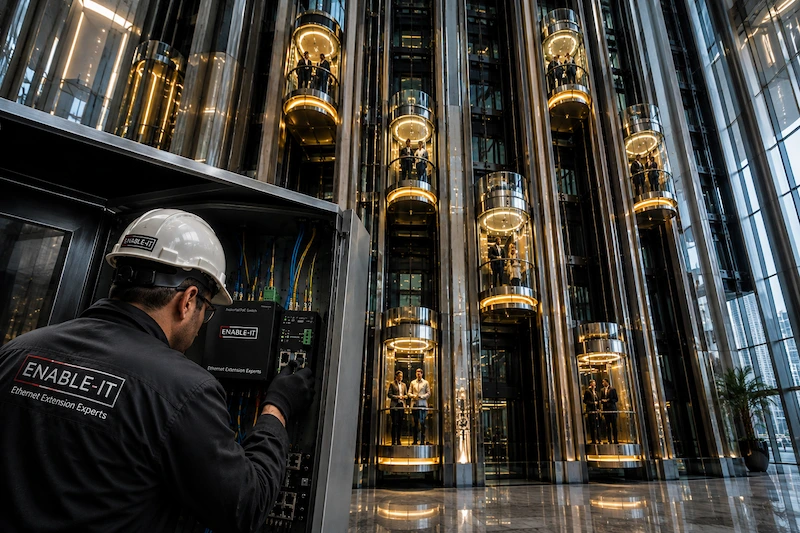

Elevator and Lift Customer Success Stories
Elevator Manufacturers
24hr Elevator
Colorado Custom Elevator & Lift
Rath-Janus / Avire – Halma
Automatisation JRT
KONE Elevator and Escalator
Modular Elevator Mfg
Mitsubishi Electric US
Schindler Elevator Corporation
Stanley Elevator Company
Phoenix Elevator
Schumacher Elevator
Delta Elevator Company
ThyssenKrupp Elevator (TKE)
Electronic Door Lift
GA Elevator
Southern Elevator Company
OTIS Elevator
Specialized Elevator
Garaventa Lift North America
National Elevator Cab & Door
Phillips Farms Elevator
SouthWest Elevators
Precision Elevator Corporation
Elevator Service
24hr Elevator
A1 Elevator Service
Deya Elevator Service
Bison Elevator Service
Midtown Elevator Co.
Peak Elevator Parts
Ski Lifts Inc.
Suncoast Elevator Solutions
Want A Free Custom Design Consultation?
We Are More Than Happy to Listen To Your Specific Project Needs.
Enable-IT Guarantees Your e-Mail Privacy 100%
Your Information Is Never Shared Or Sold.
The Unique Networking Challenge Inside an Elevator Hoistway
An elevator is one of the most demanding environments for any network cabling system. The cab moves continuously through a metal hoistway, the cable connecting it to the building must flex tens of thousands of times per year, and the signal path must remain stable at every point between ground floor and the building’s highest landing — often 100 meters or more of total vertical travel.
Modern elevator installations require reliable IP connectivity inside the cab for three distinct systems: a cab CCTV camera for security monitoring, a two-way IP emergency phone or intercom to satisfy ASME A17.1 two-way communication mandates, and increasingly, a passenger information display for floor indication, building directories, or digital advertising. Each of these devices requires both Ethernet data and power.
The conventional answer — running standard Cat6 through the trailing cable — fails for two reasons. First, the 100-meter IEEE 802.3 distance limit is frequently exceeded when the machine room is above the top floor and the total cable path includes a long horizontal run to the network closet. Second, standard Cat6 is not rated for the continuous flexing cycles of elevator service — the cable will fail mechanically long before it fails electrically.
Why wireless is not a viable alternative: RF signal attenuation in a metal hoistway is severe. Wireless bridges that perform adequately in open-air or indoor environments lose connectivity or experience severe throughput degradation inside the steel enclosure of an elevator shaft. IP emergency communication systems, cab cameras, and regulatory-required two-way devices cannot depend on a wireless link
Elevator Trailing Cable: Technical Requirements
The cable connecting the elevator machine room to the cab — called the traveling cable or trailing cable — must meet a set of mechanical and electrical requirements distinct from standard structured cabling. Enable-IT PoE Extenders are designed to operate over the wire pairs present in these cables.
Mechanical requirements
- Continuous flex rating: Elevator traveling cables must be rated for a minimum of 500,000 to 1,000,000 flex cycles, depending on duty cycle. Standard Cat5e and Cat6 solid-conductor cable is not rated for this application and will fail.
- Stranded conductors: Traveling cables use stranded (not solid) copper conductors to withstand repeated bending without wire fatigue. Enable-IT PoE Extenders operate correctly over stranded conductors.
- Jacket and insulation: Cables must have a flexible outer jacket — typically TPU (thermoplastic polyurethane) or similarly rated material — capable of withstanding the mechanical stress of continuous movement and the temperature range of the hoistway.
- Loop allowance: The traveling cable must be long enough to form a free-hanging loop at the mid-point of the hoistway travel, preventing tension and abrasion against the shaft wall. Proper loop sizing is specified in ASME A17.1.
Electrical requirements relevant to PoE Extender operation
- Conductor gauge: Most multi-conductor elevator traveling cables include 18–22 AWG pairs. Enable-IT PoE Extenders operate over 1 twisted pair at 18–22 AWG — achievable distance varies slightly by gauge; Enable-IT engineering will confirm for your specific cable.
- Pair count: Elevator traveling cables typically contain 12 to 50+ conductors in multiple pairs. Enable-IT PoE Extenders use only 1 pair (2 conductors) for both data and power — the remaining pairs remain available for elevator control wiring, lighting, and other services.
- Shielding: Select traveling cable designs include overall or individual pair shielding. Enable-IT PoE Extenders operate on shielded or unshielded pairs; a shielded pair will reduce susceptibility to interference from elevator motor VFD (variable frequency drive) noise.
VFD noise note: Variable frequency drives used in modern traction elevator motors generate significant electrical noise that can couple into unshielded signal pairs. For installations with VFD-equipped elevators, specify a shielded pair in the traveling cable for the PoE Extender interlink, or use a cable with overall shielding. Enable-IT’s team can advise on shielding specifications for your elevator type.
Compliance Standards for Elevator IP Communication Systems
The following codes and standards govern the design, installation, and operation of IP-based communication systems in elevator applications. Enable-IT PoE Extenders, as a hardwired connectivity solution, support compliance with each.
Standard / Code | Issuing Body | Relevance to Elevator IP Systems | Key Requirement |
ASME A17.1-2022 (Safety Code for Elevators and Escalators) | ASME / CSA B44 | Governs two-way communication systems in elevator cabs; mandates means-of-rescue communications | Section 2.27.1: Each elevator cab must have a means of two-way communication between the cab and a location outside the hoistway that is monitored continuously. IP-based phone and intercom systems fulfilling this requirement must maintain reliable connectivity through the trailing cable. |
NFPA 72 (National Fire Alarm and Signaling Code) | NFPA | Applies when IP-based fire alarm notification or emergency communication equipment is installed in or adjacent to elevator hoistways | Wiring and communication pathways carrying fire alarm or emergency signaling data must be survivable and meet circuit integrity requirements. Hardwired PoE extenders satisfy the physical medium requirement; wireless does not. |
NEC Article 620 (National Electrical Code) | NFPA | Specifies wiring methods for elevator, escalator, and moving walk equipment; governs conductors in hoistways and machine rooms | Conductors in hoistways must be approved for the application, including flexibility and mechanical protection. Trailing cables used with PoE Extenders must be rated for continuous flexing service (elevator traveling cable type). |
IBC / Local AHJ (International Building Code) | ICC / Local Jurisdiction | Building code compliance for emergency communication systems; applies to new construction and major renovation | Two-way emergency communication systems in elevator cabs are required in buildings meeting certain height and occupancy thresholds. IP-based solutions using PoE Extenders must demonstrate continuous, reliable operation. |
Note: Compliance determination is the responsibility of the licensed elevator contractor, AHJ, and building owner. Enable-IT provides the connectivity infrastructure — confirm final installation compliance with your elevator contractor and local authority having jurisdiction.
Typical Wiring Topology: Machine Room to Cab
The following table describes a standard Enable-IT PoE Extender installation from the machine room network closet through the elevator traveling cable to the cab devices. This topology supports an IP camera, an ASME A17.1-compliant two-way IP emergency phone, and an optional passenger information display — all powered and networked from a single wire pair
Location | Device | Connection | Notes |
Machine Room / IDF Closet | PoE Switch or PoE Injector | Cat5e/6 patch cord to Enable-IT Local Unit | Standard network switch; no modification required. PoE injector used if switch is non-PoE. |
Machine Room | Enable-IT Local Unit (e.g. 821P or 865X PRO) | RJ-45 to switch; Interlink port to elevator trailing cable | Mounts on DIN rail or in standard 1U rack tray. Draws power from PoE switch or included injector. |
Elevator Trailing Cable | Approved flexing traveling cable | 1-pair or 2-pair utilized from multi-conductor bundle | Must be rated for continuous flexing per NEC Article 620. Enable-IT operates on a single pair — remaining pairs remain available for other elevator services. |
Pit / Cable Transition Point | Cable junction / strain relief | Traveling cable transitions to fixed conduit run at pit | Properly rated strain relief fittings required at both fixed and moving attachment points per AHJ. |
Elevator Cab | Enable-IT Remote Unit | Interlink port from traveling cable; RJ-45 output ports to cab devices | Mounts inside cab electrical panel or ceiling void. Delivers PoE and Ethernet to connected devices — no separate 110V cab outlet required. |
Elevator Cab | IP Camera | Cat5e patch cord from Remote Unit PoE port | Cab CCTV camera receives both data and power from Remote Unit. 1080p or 4K operation supported. |
Elevator Cab | IP Emergency Phone / Intercom | Cat5e patch cord from Remote Unit PoE port | Two-way IP communication device for ASME A17.1 Section 2.27.1 compliance. Powered by Remote Unit — no separate power tap in cab. |
Elevator Cab | Passenger Information Display (optional) | Cat5e patch cord from Remote Unit PoE port | Floo r indicator, advertising display, or notice board. Powered and networked from the same Remote Unit. |
Single-pair efficiency: One Enable-IT PoE Extender pair — local unit in the machine room, remote unit in the cab — uses only 2 conductors of the traveling cable to deliver data and power to all cab devices simultaneously. A 865XS PRO remote unit’s 4-port output can serve an IP camera, an emergency phone, and a display from a single traveling cable pair.
Frequently Asked Questions — Elevator IP Connectivity
Q: Can a standard Cat6 cable be run through the elevator traveling cable bundle?
Standard Cat6 with solid conductors is not appropriate for elevator traveling cable service. Solid copper conductors will fatigue and fail under the continuous flexing of elevator operation — typically within months of installation. Elevator service requires stranded conductors in a flexible, mechanically rated jacket. Enable-IT PoE Extenders are designed to operate over the stranded pairs found in approved elevator traveling cables, not over solid Cat6. If your installation uses solid Cat6 inside the hoistway, this should be corrected before commissioning the data system.
Q: How does the PoE Extender handle the electrical noise from the elevator motor’s variable frequency drive?
VFD noise is a common concern in traction elevator installations. Enable-IT PoE Extenders use DSL-derived signal encoding with robust noise rejection built into the link layer. For optimal performance in high-VFD-noise environments, Enable-IT recommends using a shielded pair in the traveling cable for the extender interlink connection, with shield continuity maintained from machine room to cab. This approach is consistent with best practices for any sensitive signal pair in an elevator traveling cable. Enable-IT engineering will advise on shielding specifications for your specific elevator make and model.
Q: Does using a PoE Extender in the elevator traveling cable satisfy ASME A17.1 two-way communication requirements?
ASME A17.1 Section 2.27.1 requires a means of two-way communication between the cab and a continuously monitored location outside the hoistway. The standard specifies the functional requirement — reliable, continuous two-way communication — not the specific technology. An IP-based emergency phone or intercom powered and connected through an Enable-IT PoE Extender satisfies the functional requirement, provided the overall system (phone device, extender, network, and monitoring endpoint) is installed, tested, and maintained per the standard. Final compliance determination rests with the licensed elevator contractor and the authority having jurisdiction. Enable-IT provides the connectivity infrastructure that supports a compliant IP solution.
Q: How many devices can be powered and connected in the elevator cab from one PoE Extender installation?
The Enable-IT 821P remote unit provides one PoE output port — appropriate for installations requiring a single device such as a cab camera or an emergency phone. The 865XS PRO provides four PoE output ports at the remote end, allowing a single traveling cable pair to simultaneously support an IP camera, an ASME-compliant two-way IP emergency phone, and a passenger information display — all from one wire pair and one machine-room-mounted local unit. For installations where the power draw of all connected devices combined exceeds 60 watts, contact Enable-IT to confirm the power budget or evaluate the 865Q PRO (75 W, 8-pair) for higher-wattage requirements.
Q: Can an Enable-IT PoE Extender be used in a hydraulic elevator as well as a traction elevator?
Yes. Enable-IT PoE Extenders are not elevator-type specific — they operate over any twisted pair that meets the electrical requirements (conductor gauge, continuity, and shielding as applicable). Hydraulic elevators typically involve shorter total travel distances and may have different traveling cable configurations than traction elevators, but the extender installation principle is identical: local unit in the machine room connected to the network; remote unit in the cab connected to IP devices; interlink over one pair of the traveling cable. Enable-IT engineering will review your specific hydraulic elevator configuration and confirm compatibility before you order.
Planning an elevator IP camera, emergency phone, or display installation?
Enable-IT engineers have been solving elevator connectivity challenges for over two decades. We will review your traveling cable type, device power requirements, hoistway distance, and VFD environment before you order — at no charge.
Call (888) 309-0910 Monday–Friday, 7AM–4PM PST, or use the live chat on this page.