Global Disaster Communication Solutions: How Rescue Teams Keep the Lifeline Open When Everything Else Fails
When a Category 5 hurricane makes landfall, a 7.8-magnitude earthquake levels a city, or wildfire jumps a containment line, the first casualty is almost always the same: **communication**.
Cell towers topple. Fiber lines shear. Power grids collapse. And in that silence — often within the first 72 hours, when survival rates are decided — rescue teams, medical units, and relief coordinators are forced to operate blind.
Every disaster response professional knows the brutal math: **coordination saves lives, and coordination requires connectivity.** A search-and-rescue team that can’t reach its command center is a team searching the wrong grid. A field hospital that can’t transmit patient data is triaging on guesswork. A relief convoy without a network is delivering supplies to yesterday’s crisis.
At Enable-IT, we’ve spent over two decades engineering the secure, long-distance Ethernet and PoE Extender infrastructure that keeps these lifelines open — the same battle-tested technology trusted by the US military, NASA, and government networks since 1997. This guide breaks down the full disaster communications toolkit — short-term and long-term — and shows you where the hidden weak point lives in nearly every deployment, and how to eliminate it.

The Overlooked Truth About Disaster Communications
Here’s what most disaster recovery planning gets wrong: it obsesses over the *wireless* layer — satellites, cell towers, radios — while ignoring the wired backbone that makes all of it work.
Every satellite terminal, WiFi access point, cellular repeater, and radio base station in a disaster zone shares two dependencies:
1. **Data backhaul** — a stable connection tying field equipment into a unified network
2. **Power delivery** — electricity in an environment where the grid no longer exists
This is precisely where **Ethernet Extender and PoE Extender technology** becomes the strategic advantage. A single extended cable run delivers both data and power to equipment positioned exactly where responders need it — a repeater on a ridgeline, a camera over a flooded river crossing, an access point deep inside a shelter — at distances conventional Ethernet simply cannot reach.
Standard Ethernet dies at 328 feet (100 meters). **Enable-IT solutions extend secure, high-throughput connectivity out to 9,000 feet (2,743 m)** — over virtually any existing wire, including legacy copper and coax already buried in the disaster zone. When the infrastructure above ground is destroyed, the wiring below it often survives. We help you weaponize it for recovery.
Short-Term Disaster Communication Solutions: The First 72 Hours
Immediate-response tools must deploy fast, run on minimal power, and work when everything else doesn’t. Here’s how the four core technologies stack up — and how a wired extension layer multiplies each one.
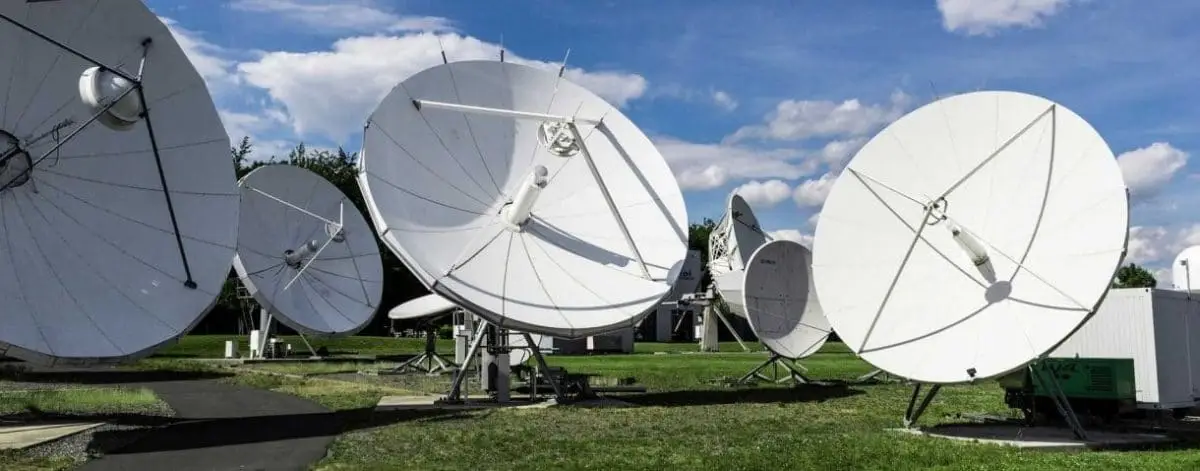
1. Satellite Phones — Instant Voice, Anywhere on Earth
Satellite phones bypass destroyed terrestrial infrastructure entirely, connecting directly to orbiting constellations. They were the lifeline for responders after Hurricane Katrina flattened cell coverage across Louisiana, and again in Nepal’s 2015 earthquake when rescue teams coordinated across mountain terrain with zero cellular service.
**The limitation:** a satphone serves one user at a time, at painful per-minute rates, with latency and weather sensitivity.
**The Enable-IT multiplier:** A PoE-powered satellite terminal paired with extended Ethernet transforms a single satellite uplink into a **networked communications hub** — VoIP phones, laptops, and data terminals for an entire command post, running over one secure backhaul, with power delivered down the same cable.
2. Portable WiFi Hotspots — Reconnecting Survivors and Responders
After Hurricane Maria destroyed over 90% of Puerto Rico’s cell towers, and during Australia’s 2020 bushfires, portable and airborne WiFi became the fastest way to restore public connectivity. Survivors could reach family; responders could sync operations.
**The limitation:** coverage measured in hundreds of feet, and wireless links that buckle under congestion.
**The Enable-IT multiplier:** PoE Extenders push access points **thousands of feet from the gateway** — into shelters, staging areas, and triage tents — over hardwired links that don’t degrade with interference or user load. One uplink becomes a resilient, wide-area mesh with wired stability at its core.
3. Cellular Signal Boosters — Amplifying What's Left
When towers are damaged but not destroyed — as during the 2018 California wildfires and the 2021 Texas winter storm — signal boosters restore usable coverage for a fraction of the cost of portable towers.
**The limitation:** boosters need power and placement, and the best signal is rarely where the outlets are.
**The Enable-IT multiplier:** PoE-powered repeaters can be mounted precisely where signal capture is strongest — rooftops, hilltops, towers — with data and power delivered over a single extended run. No generator drops. No electrician. No compromise on placement.

4. Two-Way Radios — The Last Line That Never Goes Down
Radio remains the gold standard for first-responder voice traffic. It carried the load on 9/11 when cell networks collapsed under demand, and coordinated food distribution after Haiti’s 2010 earthquake.
**The limitation:** range is hostage to terrain, and analog radio can’t carry data.
**The Enable-IT multiplier:** Extended Ethernet links PoE-powered repeater stations across valleys, urban canyons, and collapsed zones — and bridges radio traffic into modern IP-based command systems, so police, fire, and medical teams operate on one coordinated picture instead of three isolated channels.

Long-Term Disaster Communication Solutions: Rebuilding Resilience
When response transitions to recovery, the requirements change: temporary becomes permanent, portable becomes scalable, and every dollar of infrastructure must survive the *next* disaster too.
### Satellite Ground Stations
After Hurricane Dorian devastated the Bahamas in 2019, fixed satellite ground stations with Ethernet and PoE-powered networking restored regional communications for the long rebuild. Extended Ethernet distributes that satellite capacity across entire recovery zones — government offices, hospitals, schools — from a single uplink.
### Permanent WiFi Mesh Networks
Following Nepal’s earthquake, PoE-powered outdoor access points reconnected remote villages that had never had robust infrastructure. Self-healing mesh topology plus hardwired extended-Ethernet trunk lines between key nodes delivers coverage that scales as recovery progresses — without trenching new conduit or installing power at every node.
### Restored Cellular Infrastructure
Puerto Rico’s post-Maria recovery leaned on PoE-based microcells with Ethernet backhaul to bring 4G LTE back where towers had been erased. Small-cell architecture powered and fed by extended Ethernet rebuilds coverage faster and at dramatically lower cost than full tower reconstruction.
### Integrated Emergency Radio Networks
Japan’s response to the 2011 earthquake and tsunami included PoE and Ethernet-connected radio repeaters that still serve disaster monitoring and public alerting today — proof that a properly engineered wired backbone isn’t a stopgap. It’s permanent civil-defense infrastructure.
—
## Why Enable-IT Is the Strategic Advantage in Disaster Recovery
Any vendor can sell you a PoE injector. Very few can tell you their equipment is deployed on the International Space Station, runs on US Navy submarines, and has secured US Government networks since 1997. Here’s what separates Enable-IT solutions when lives are on the line:
**✔ Unmatched Distance — 9,000 ft / 2,743 m.** Extend secure Ethernet nearly two miles over a single run — 27 times the standard limit — reaching command posts, sensors, and repeaters wherever the mission requires.
**✔ Works Over Any Existing Wire.** Coax, legacy telephone pairs, even barbed wire fencing. In a disaster zone, surviving copper is everywhere. Our technology turns it into a high-throughput network without laying a foot of new cable.
**✔ Trusted Secure Encryption.** Emergency operations move sensitive data — casualty information, tactical positioning, critical infrastructure status. Our solutions are engineered for the security standards of military, aerospace, and government customers, because those *are* our customers.
**✔ Power + Data on One Cable.** Every PoE Extender deployment eliminates a generator, a fuel run, and a point of failure. In the field, simplicity is survivability.
**✔ Made in the USA. Proven Since 1999.** Enable-IT pioneered the Ethernet Extender and PoE Extender categories and manufactures in America under aerospace-grade quality standards — with a GSA Schedule for streamlined government and agency procurement.
**✔ Live Human Engineering Support.** When you call during a deployment, you reach an engineer — not a ticket queue. Mission-critical customers get mission-critical support.
Key Benefits of PoE and Ethernet for Long-Term Disaster Solutions
✔ Power and Data in One Cable – Simplifies installation and reduces infrastructure costs.
✔ Scalability – Supports expanding networks as recovery progresses.
✔ Reliability – Wired Ethernet is more stable than wireless in harsh environments.
✔ Energy Efficiency – PoE minimizes power consumption, ideal for disaster-prone areas.
✔ Supports Multiple Applications – Powers surveillance, remote sensors, emergency phones, and more.

Short-Term Disaster Communication Solutions
When disaster strikes, immediate communication is essential for coordinating rescue efforts, deploying emergency services, and keeping affected populations informed. Short-term communication solutions are designed to be fast to deploy, portable, and scalable, ensuring first responders and relief teams can quickly establish connectivity in critical areas.
Unlike long-term infrastructure-based solutions, short-term disaster communication systems prioritize mobility, low power consumption, and ease of use. They serve as a bridge between initial response and full recovery, helping communities stay connected until permanent infrastructure is restored.
1. Satellite Phones: Instant Communication in Any Terrain
How It Works:
Satellite phones operate by connecting directly to orbiting satellites instead of terrestrial cell towers. They are commonly used in remote or disaster-stricken areas where traditional mobile networks are unavailable or inoperable.
Pros:
✔ Works anywhere in the world – No reliance on ground-based infrastructure.
✔ Battery-powered and portable – Can be used immediately after a disaster.
✔ Independent of local power grids – Functions even when electricity is out.
Cons:
✖ Expensive to operate – High per-minute call and data costs.
✖ Signal latency – Communication can have a delay, especially with geostationary satellites.
✖ Weather-dependent – Heavy clouds, storms, or obstructions can interfere with signals.
Use in Disaster Scenarios:
- Hurricane Katrina (2005): Emergency responders relied heavily on satellite phones when cell towers were destroyed across Louisiana and Mississippi.
- Nepal Earthquake (2015): Relief workers used satellite communication to coordinate rescue missions in mountainous regions where cellular networks were down.
Role of PoE & Ethernet:
- PoE-powered satellite terminals allow responders to create a networked satellite communication hub.
- Ethernet-connected VoIP phones using satellite backhaul provide a more stable, multi-user solution compared to standalone satphones.
2. Portable WiFi Hotspots: Restoring Internet Access for Survivors and First Responders
How It Works:
Portable WiFi hotspots use cellular or satellite networks to create an internet access point. These devices provide connectivity for disaster response teams, emergency shelters, and affected communities.
Pros:
✔ Quick setup – Can be deployed within minutes to restore internet access.
✔ Supports multiple users – Enables WiFi access for responders, medical teams, and displaced residents.
✔ Works with existing devices – People can connect using their smartphones, laptops, and tablets.
Cons:
✖ Limited range – Coverage is typically restricted to a few hundred feet.
✖ Dependent on cellular networks – If cell towers are down, alternative solutions are needed.
✖ Bandwidth limitations – Can become overloaded in high-traffic areas.
Use in Disaster Scenarios:
- Hurricane Maria (2017): Google deployed Project Loon, a balloon-based WiFi network, to restore connectivity in Puerto Rico when over 90% of cell towers were destroyed.
- Australia Bushfires (2020): Emergency teams used portable satellite WiFi hotspots in burned-out rural areas where traditional networks were gone.
Role of PoE & Ethernet:
- PoE-powered WiFi access points allow responders to establish mesh networks in refugee camps and disaster zones.
- Ethernet backhaul connections provide a more stable, wired alternative to overloaded wireless links.

3. Cellular Signal Boosters: Enhancing Weak Signals in Disaster Areas
How It Works:
Cellular signal boosters amplify weak mobile signals, making it easier for people in disaster-affected areas to make calls and access mobile data. These systems are particularly useful when cell towers are damaged but still operational.
Pros:
✔ Cost-effective solution – Cheaper than deploying portable cell towers.
✔ Improves call quality and data speeds – Enhances communication reliability.
✔ Can cover large areas – Useful for emergency shelters and command centers.
Cons:
✖ Requires an existing cellular signal – Cannot work if there’s total network failure.
✖ Limited range – Boosted signals degrade over distance.
✖ Power-dependent – Requires backup generators in disaster areas.
Use in Disaster Scenarios:
- California Wildfires (2018): Signal boosters were used to help firefighters and rescue teams maintain communication in mountainous and rural areas with weak coverage.
- Texas Winter Storm (2021): First responders deployed mobile boosters to strengthen weak signals after cell towers were overloaded with emergency calls.
Role of PoE & Ethernet:
- PoE-powered cellular repeaters reduce power requirements for emergency deployments.
- Ethernet links to small cell networks improve connectivity in areas where cellular backhaul is weak.
4. Two-Way Radios: Reliable, Instant Communication for Emergency Responders
How It Works:
Two-way radios use radio frequencies (VHF or UHF) to transmit voice communications between responders. Unlike cellular phones, they do not require external networks, making them a lifeline during total communication failures.
Pros:
✔ Works independently of cell towers and internet – Ideal for worst-case scenarios.
✔ Instant, push-to-talk communication – Faster than dialing phone numbers.
✔ Extremely durable and weather-resistant – Designed for rugged conditions.
Cons:
✖ Limited range – Coverage depends on radio power and terrain.
✖ No data or internet capability – Only suitable for voice communication.
✖ Requires frequency coordination – Channels can become congested during large-scale disasters.
Use in Disaster Scenarios:
- 9/11 Attacks (2001): First responders in New York relied heavily on two-way radios when cell networks became overloaded.
- Haiti Earthquake (2010): Relief organizations used radio networks to coordinate food distribution and rescue efforts.
Role of PoE & Ethernet:
- PoE-powered repeater stations extend radio range without requiring complex wiring.
- Ethernet-based IP radio systems integrate with emergency command centers for seamless coordination across regions.
The Role of PoE and Ethernet in Short-Term Disaster Solutions
In short-term disaster recovery, Power over Ethernet (PoE) and Ethernet networks help emergency teams quickly deploy scalable, reliable, and efficient communication infrastructure.
Key Benefits of PoE & Ethernet in Disaster Response:
✔ Reduces power dependency – PoE devices run on a single cable, eliminating the need for separate power sources.
✔ Rapid deployment – No need for complex electrical installations.
✔ Improves network stability – Ethernet provides faster, more secure connections than wireless-only setups.
✔ Scalable – PoE switches and Ethernet backhaul can support large-scale disaster operations.
Real-World Applications:
- Mobile Emergency Shelters: PoE-powered WiFi, radios, and LED lighting provide connectivity and safety for displaced populations.
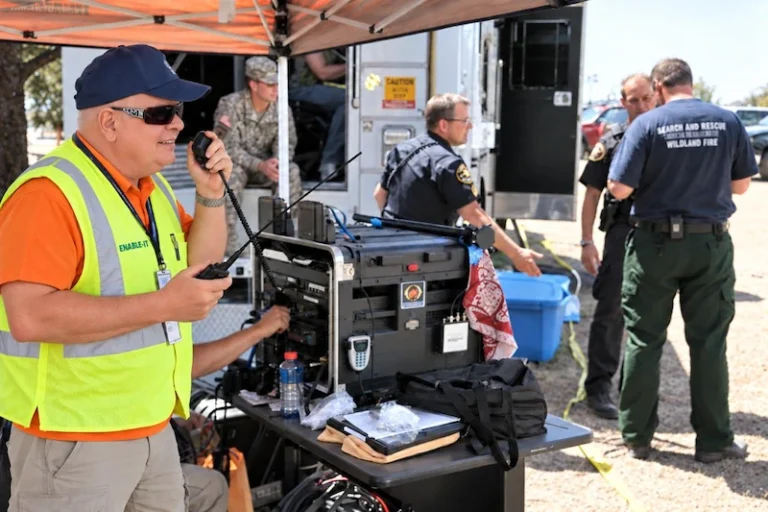
- Field Command Centers: Ethernet backhaul connects satellite modems, cellular boosters, and WiFi hotspots into a unified system.
- First Responder Networks: PoE-based radio repeaters and network switches ensure stable communication between police, fire, and medical teams.
Short-term solutions like satellite phones, portable WiFi hotspots, signal boosters, and two-way radios are lifesaving tools in disaster zones. When combined with PoE and Ethernet-based networks, they become more resilient, scalable, and efficient, ensuring uninterrupted communication when it matters most.

The Future of PoE and Ethernet in Disaster Recovery
Long-term disaster recovery efforts require smart, resilient, and scalable communication solutions. PoE and Ethernet are at the core of next-generation emergency networks, providing:
✅ Permanent Infrastructure Support – Enables long-lasting communication hubs.
✅ Smart Monitoring & IoT Integration – Supports sensors, surveillance, and automation.
✅ Energy Efficiency & Off-Grid Power – Works with solar and backup power solutions.
✅ Disaster-Proof Networks – Weather-resistant, durable, and easy to maintain.
By leveraging PoE and Ethernet, long-term disaster communication networks become more stable, efficient, and future-proof, ensuring communities remain connected long after the immediate crisis has passed.

The Bottom Line: Resilience Is a Decision You Make Before the Disaster
Climate volatility is making major disasters more frequent, more intense, and more expensive. The organizations that maintain communications through the chaos aren’t lucky — they’re prepared. They built **robust, redundant, scalable** network infrastructure while the sky was still blue.
Satellite, WiFi, cellular, and radio each play a role. But the backbone that binds them into one resilient, secure, powered network — that’s Ethernet and PoE Extension. And that’s Enable-IT.
Don't Wait for the Next Disaster to Discover Your Network's Breaking Point
Whether you’re an emergency management agency hardening critical infrastructure, a relief organization building rapid-deployment kits, or a government entity procuring through GSA Schedule, our engineers will design a disaster-resilient communications solution around your exact requirements.
**📞 Call (888) 309-0910** — Mon–Fri, 5AM–4PM PST — and speak directly with an Enable-IT solutions engineer.
**🛠 [Request Your Free Custom Design Consultation →](https://enableit.com/free-custom-design-consultation/)**
*Enable-IT: Extending secure Ethernet beyond every limit — because when disaster strikes, connection is survival.*

Extend any Ethernet Cable Beyond the Limits with Enable-IT Solutions !
The benefit of buying an Ethernet Extender from Enable-IT because our equipment leverages high throughput telecom signals over any wire – including coax, barbed wire fence, etc. Enabling distances unheard of in the industry. There are Ethernet Extender Solutions available that can extend this distance limit out to 9,000 feet or 2,743 m.
The industry uses are endless – as everyone has a need for extended Ethernet many times in their lifetime and sooner than later the need will arise and we are ready when you are to help select a solution.
Diverse Industry customers include the US, UK and Canadian Military; NASA; Aerospace manufacturers; Nautical Infrastructure (Marinas, Mega Yachts, Cruise Ships,Port facilities, US Nuke sub fleet, etc); Video Surveillance and Security Specialists; Advanced Telecommunications companies; Extreme Mining Operators; Global Construction Enterprises; Commercial Agriculture companies; major Healthcare providers; Live Entertainment, Broadcasting, and News agencies; Extreme Retail/POS organizations; Long-Distance Education Companies; International Hospitality Companies; Elevator manufacturers, Digital Signage and much more.