
History of Ethernet. Who Invented It and When Was Ethernet Invented
The invention of Ethernet was developed under the supervision of Robert Metcalfe at Xerox in 1973 at the Xerox Palo Alto Research Center, and the 1976 patent listed Metcalfe, David Boggs, Butler Lampson, and Chuck Thacker as co-inventors. With the development of home internet services in the 1980s and 1990s, this technology, which expanded to include the adapter and port options on new PCs, began to create a way for home computer networking. Which helped create new opportunities for developing the technology because it existed before many other types of computer connectivity, such as USB or Universal Serial Bus. (Yes, USB like most modern smartphone cord cables.)
Robert Metcalfe
Robert is known for being a co-inventor of ethernet and also 3Com. A corporation that was an American digital electronics manufacturer that made computer networking products. 3Com was co-founded in 1979 by Robert Metcalfe, Howard Charney, and others. Mr. Metcalfe shared that the company name “3Com” was in reference to “Computer, Communication, and Compatibility”, with the sole focus on Ethernet technology. Robert Metcalfe is currently a retired Professor of Innovation and Entrepreneurship and Murchison Fellow of Free Enterprise in the Cockrell School of Engineering at The University of Texas in Austin.

“In late 1972, Metcalfe and his Xerox PARC colleagues developed the first experimental Ethernet system to interconnect the Xerox Alto, a personal workstation with a graphical user interface. The experimental Ethernet was used to link Altos to one another, and to servers and laser printers. The signal clock for the experimental Ethernet interface was derived from Alto’s system clock, which resulted in a data transmission rate on the experimental Ethernet of 2.94 Mbps.” – Source
“Metcalfe’s first experimental network was called the Alto Aloha Network. In 1973 Metcalfe changed the name to “Ethernet,” to make it clear that the system could support any computer-not just Altos-and to point out that his new network mechanisms had evolved well beyond the Aloha system. He chose to base the name on the word “ether” as a way of describing an essential feature of the system: the physical medium (i.e., a cable) carries bits to all stations, much the same way that the old “luminiferous ether” was once thought to propagate electromagnetic waves through space. Thus, Ethernet was born.” – Source
The Idea
Metcalfe was tasked with developing a way for computers to communicate with each other over long distances. At the time, the primary method of data transmission was through telephone lines, which was not suitable for transmitting large amounts of data at high speeds.
Metcalfe’s solution was to create a new type of network that used coaxial cables to transmit data. This network was called Ethernet, and it allowed computers to communicate with each other at speeds of up to 10 megabits per second (Mbps). This was a significant improvement over the previous method of data transmission and opened up new possibilities for computer networking.
How Does Ethernet Work?
Complex connections to different local networks are possible due to ethernet technology. Similar to how a phone line works, an ethernet cable or ethernet cord connects a computer to a router. The range of linked ethernet products can be extended by using accessory products such as splitters and ethernet extenders. A high-speed ethernet connection to a device is possible with an Ethernet connection when the device is linked to a router. Many electronic devices like TVs, video game consoles, video surveillance cameras, VOIP phones, printers, industrial equipment, and much more use ethernet connections, even though most people know and associate them with just computers.

Impact of Ethernet on Modern Networking
Ethernet has had a profound impact on modern networking. It has become the foundation of the LAN, which is an essential component of businesses and organizations worldwide. LANs allow multiple computers to connect and share data with each other, making it easier to collaborate and work on projects.
Ethernet has also made it possible for the internet to function. The internet is essentially a massive network of networks that are connected through Ethernet and other networking technologies. Without Ethernet, the internet as we know it today would not exist.
In addition to its impact on LANs and the internet, Ethernet has also influenced other networking technologies. For example, Wi-Fi, which is a wireless networking technology, is based on Ethernet. Wi-Fi uses radio waves instead of cables to transmit data, but the underlying technology is still Ethernet.
How is 802.3 Ethernet Used Today?
Ethernet used to be mostly used in offices and educational institutions. Ethernet is now a very popular way to connect computers and many different devices together. Ethernet has become even more popular in recent years. The demand for wired networking over wireless is growing, and gigabit Ethernet is becoming more and more common. For those who require heavy network bandwidth, gigabit Ethernet is an excellent option because it is much quicker and allows for more devices to be connected than regular Ethernet.
Ethernet FAQ
What is IEEE 802.3 Ethernet?
IEEE 80-2.3 (Ethernet) is a LAN protocol that allows computers to communicate with each other over a wired connection. It’s the most common type of network used in homes and offices, and it is used to connect servers. Ethernet cables are responsible for sending data between two points via electrical signals. Ethernet cables are usually yellow and have either an RJ-45 or an RJ-48 jack on each end. Ethernet networks can be wired together, but they are more commonly connected wirelessly. The standard Ethernet connection speed is 10 Mbit/s, but more advanced networking equipment has been developed to increase the speed of Ethernet connections. Learn more about what is Ethernet technology.

What Does Ethernet Do?
Ethernet is used for connecting devices to a local area network (LAN) or wide area network (WAN). Ethernet is a very versatile technology that can be used for many different applications. It’s commonly used for networking computers, but it can be used for devices other than computers as well.
Which is better Ethernet or Wifi?
Ethernet generally outperforms Wi-Fi in speed and reliability because it is directly connecting each device with a cable so there is less interference for the signal to drop and lose speed and network data in transmission.
The advent of Ethernet has brought about a transformative impact on communication, data sharing, and connectivity. Devised by Bob Metcalfe in the early 1970s, Ethernet stands as the fundamental building block of contemporary local area networks (LANs). Its significance in modern networking cannot be overstated, as it enables swift data transmission and facilitates seamless collaboration on various projects. The existence of today’s internet owes much to the existence of Ethernet. In response to escalating demands in networking, Ethernet continues to evolve, with ongoing advancements in standards and technologies.
Undoubtedly, Ethernet has emerged as a paramount invention with pervasive applications in both personal and professional spheres. Therefore, it is crucial to delve into the historical origins of Ethernet and comprehend its journey towards the present-day technology we rely on. Equally important is developing an understanding of how Ethernet functions and how it can be integrated into everyday life scenarios.

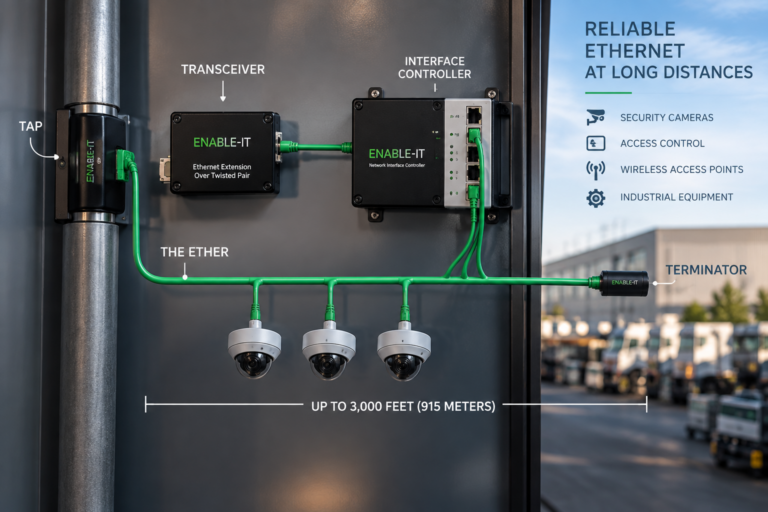
Extend any Ethernet Cable Beyond the Limits with Enable-IT Solutions !
The benefit of buying an Ethernet Extender from Enable-IT because our equipment leverages high throughput telecom signals over any wire – including coax, barbed wire fence, etc. Enabling distances unheard of in the industry. There are Ethernet Extender Solutions available that can extend this distance limit out to 9,000 feet or 2,743 m.
The industry uses are endless – as everyone has a need for extended Ethernet many times in their lifetime and sooner than later the need will arise and we are ready when you are to help select a solution.
Diverse Industry customers include the US, UK and Canadian Military; NASA; Aerospace manufacturers; Nautical Infrastructure (Marinas, Mega Yachts, Cruise Ships,Port facilities, US Nuke sub fleet, etc); Video Surveillance and Security Specialists; Advanced Telecommunications companies; Extreme Mining Operators; Global Construction Enterprises; Commercial Agriculture companies; major Healthcare providers; Live Entertainment, Broadcasting, and News agencies; Extreme Retail/POS organizations; Long-Distance Education Companies; International Hospitality Companies; Elevator manufacturers, Digital Signage and much more.