Emergency Food Relief Operations: Why the Difference Between Feeding Thousands and Feeding No One Comes Down to Communications
Emergency Food Disaster Relief Operations: Why the Difference Between Feeding Thousands and Feeding No One Comes Down to Communications.
Within hours of a major disaster — hurricane, earthquake, flood, or wildfire — a race begins that most people never see. While search-and-rescue dominates the headlines, a second mission with equally unforgiving math is spinning up in parallel: **feeding tens of thousands of displaced people, three times a day, indefinitely, in a place where the infrastructure just died.**
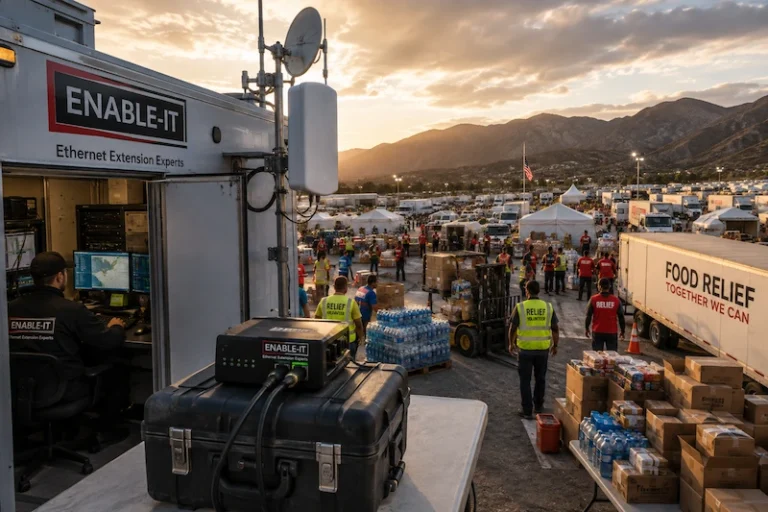
Relief organizations know the brutal arithmetic. A distribution operation serving 50,000 survivors moves hundreds of tons of food, water, and supplies daily through improvised warehouses, staging yards, field kitchens, and distribution points — all of which appeared overnight, and none of which came with a network.
And here is the truth every logistics chief learns the hard way: **Emergency Food Disaster Relief doesn’t fail because there isn’t enough food. It fails because the people moving it can’t communicate.** Trucks arrive at sites that closed hours earlier. Refrigerated cargo spoils because nobody saw the reefer unit fail. Two agencies deliver to the same shelter while a third shelter goes hungry. Distribution lines collapse into chaos because registration systems have no connectivity.
At Enable-IT, we’ve spent more than two decades building the secure, long-distance Ethernet and PoE Extender infrastructure that keeps mission-critical operations connected — technology trusted on US Government and military networks since 1997, and aboard the International Space Station. This is how that same technology becomes the invisible backbone of a food relief operation that actually works.
The Anatomy of a Food Relief Operation — and Where It Breaks
A disaster-zone food operation is a supply chain built at combat speed. Each link depends on data moving reliably between points that are hundreds or thousands of feet apart, across facilities that were never wired for it:
**Receiving & warehousing.** Donated and purchased food arrives by the truckload at commandeered warehouses, airport aprons, and parking lots. Without networked inventory systems at the receiving docks, pallets vanish into the pile — and relief agencies routinely report losing track of significant inventory in the first chaotic week.
**Cold chain custody.** Perishables and medical nutrition products live or die by refrigeration. Reefer trailers and cold rooms scattered across a staging yard need continuous temperature monitoring — networked sensors, not a volunteer with a clipboard walking the yard every four hours. One unnoticed compressor failure can destroy a community’s protein supply overnight.
**Field kitchens & distribution points.** Organizations like those that served millions of meals after Hurricane Maria and the Türkiye earthquakes operate dozens of simultaneous serving sites. Each needs coordination with central command: meal counts, supply requests, crowd conditions, opening and closing times.
**Registration & fair distribution.** Digital beneficiary registration prevents both duplication and gaps — but only if the tablets and terminals at the head of the line have connectivity. When systems go down, lines stall, tensions rise, and the most vulnerable people are the ones turned away.
**Site security.** Food is currency in a disaster zone. Warehouses and distribution points require surveillance coverage — cameras positioned at perimeters, gates, and storage areas, often far from any power source or network drop.
Every one of these functions shares the same two dependencies: **data connectivity and electrical power, delivered to places that have neither.**
The Connectivity Trap: Why Standard Solutions Fall Short in the Field
Emergency Food Disaster Relief IT teams typically reach for three tools, and each hits a wall:
**Standard Ethernet dies at 328 feet (100 meters).** A commandeered warehouse is often 500–1,000 feet deep. The staging yard stretches farther. The distribution tent is across the parking lot. The IEEE 802.3 limit turns every camera, access point, sensor, and terminal beyond 328 feet into a stranded asset.
**Wireless buckles exactly when you need it.** Congested spectrum, metal warehouse structures, weather, and hundreds of survivors’ phones hammering every access point make RF links the least dependable path for operational data — and an unencrypted one at that, in an environment where beneficiary data and security feeds demand protection.
**Generators can’t be everywhere.** Every remote camera or sensor that needs its own power drop means another generator, another fuel run, another failure point in an operation already stretched thin.
The Enable-IT Advantage: One Cable, Power + Data, Miles of Reach
This is precisely the problem Enable-IT solutions were engineered to eliminate. Our Ethernet Extender and PoE Extender technology delivers **secure network data and electrical power together, over a single wire, at distances up to 9,000 feet (2,743 m)** — nearly two miles, and up to 27 times beyond the standard Ethernet limit.
For a food relief operation, that changes the entire deployment equation:
**✔ Turn any surviving wire into infrastructure.** Our technology runs over virtually any copper pair — legacy telephone wiring, control cable, even coax. Commandeered warehouses, schools, and municipal buildings are full of dormant copper that survived the disaster. Enable-IT turns it into a gigabit-class network in minutes, with zero configuration. Plug and go.
**✔ Power the far edge without generators.** PoE Extender solutions push Power over Ethernet — data and electricity — up to 4,000 feet down a single wire. Perimeter cameras, temperature sensors on distant reefer trailers, WiFi access points over distribution lines, and registration terminals at the head of the queue all run from one central, protected power source.
**✔ Trusted Secure Encryption end to end.** Beneficiary records, security video, and operational traffic move encrypted between Enable-IT devices — engineered to the standards of our military, aerospace, and government customers, because those are our customers. In an environment where desperate actors target food logistics, that isn’t a luxury.
**✔ Ruggedized for the environment relief teams actually work in.** Extreme-temperature, professional-grade enclosures built for outdoor staging yards, unconditioned warehouses, and weather that follows the disaster in.
**✔ Deployable by non-specialists.** Relief operations run on volunteers and exhausted staff. Our solutions require no network engineering: connect the wire, plug in the units, and the link is live.
**✔ USA-made, GSA Schedule ready.** Enable-IT manufactures in our AS9100D aerospace-certified US facility, ships factory-floor direct the same day, and holds a GSA Schedule — so FEMA-aligned agencies, state emergency management, and government-funded relief programs can procure without friction. Every unit is backed by a lifetime warranty and live US-based engineering support.
A Deployment Blueprint: Networking a Food Distribution Hub in One Day
Picture the assignment: a 90,000 sq ft donated warehouse, a 15-acre staging yard with 22 reefer trailers, a drive-through distribution lane, and a walk-up serving area — connected to one satellite uplink at the command trailer.
**Morning:** Ethernet Extender links run from the command trailer over the building’s existing phone wiring to receiving docks 800 feet away. Inventory scanning goes live before the first truck backs in.
**Midday:** PoE Extender runs push powered temperature sensors and cameras across the staging yard — no trenching, no generators, each reefer trailer now reporting continuously to command.
**Afternoon:** Extended PoE links light up WiFi access points and registration terminals at the distribution lanes, a quarter mile from the uplink. Beneficiary check-in runs at full speed through the evening meal service.
One satellite connection. One protected power source. An entire operation, connected and secured — deployed in the time it takes to unload the first convoy.
Resilience Is Built Before the Storm
The organizations that feed people fastest after a disaster are the ones whose deployment kits were packed before it. Ethernet and PoE Extender units are small, light, rugged, and configuration-free — which makes them ideal permanent residents of every relief organization’s rapid-response inventory, alongside the generators and the satellite terminals they multiply.
Whether you’re an emergency management agency, a disaster relief NGO, a food bank network hardening its hub-and-spoke model, or a government program procuring through GSA Schedule — the time to design your communications backbone is now, while the sky is blue.
## Let’s Design Your Relief Communications Backbone — Free
Tell our engineers your scenario: the facilities you’d occupy, the distances involved, the wiring likely on hand. We’ll design a deployment-ready solution around it, at no cost — from the seminal inventors of the Ethernet Extender and PoE Extender industries.
**📞 Call (888) 309-0910** — Mon–Fri, 5AM–4PM PST — and speak directly with a US-based Enable-IT solutions engineer.
**🛠 [Request Your Free Custom Design Consultation →](https://enableit.com/free-custom-design-consultation/)**
*Enable-IT: Extending secure Ethernet beyond every limit — because when disaster strikes, feeding people starts with connecting them.*
Short-Term Food Relief Solutions
In the wake of a disaster, food security takes immediate precedence. Short-term solutions are critical to provide quick, effective relief to affected populations. These solutions focus on scalable, portable, and fast-acting systems to ensure food is produced, distributed, stored, treated, and safely consumed in the early stages of recovery. The role of Ethernet and PoE (Power over Ethernet) technologies becomes evident in enabling communication, automation, and monitoring to enhance the effectiveness of these solutions.
1. Emergency Food Production
In the aftermath of a disaster, setting up systems for emergency food production is crucial to ensuring immediate access to nutrition, particularly in areas where infrastructure has been disrupted.
- High-Efficiency Greenhouses: Portable greenhouses equipped with PoE-powered climate control systems allow for rapid food production even in environments where traditional farming is not possible. These greenhouses can be moved into affected areas, providing shelter for crops and optimizing growth conditions. PoE technology is used to power automated systems for regulating temperature, humidity, and light, reducing the need for manual oversight. The integration of solar panels can make these greenhouses independent from the local power grid, allowing them to function even in off-grid locations.
Example: A disaster-hit community can set up a high-efficiency greenhouse with PoE-powered LED lights and automated irrigation to grow fast-maturing crops like leafy greens, which are ideal for rapid harvest in the aftermath of a crisis.
- Temporary Hydroponic Units: These soil-less farming systems use water-based solutions to grow plants, making them perfect for emergency food production in areas where the soil has been contaminated or is unavailable. PoE-connected sensors can monitor water levels, nutrient concentration, and pH balance to optimize plant growth. These units can be set up in temporary shelters or community centers, providing immediate food access.
Example: In the aftermath of a flood, hydroponic units could be installed in nearby community centers, providing residents with access to fresh vegetables within days of the disaster.
Pros:
✔️ Rapid production of food in any environment.
✔️ Requires less space and water compared to traditional farming.
✔️ PoE-powered automation reduces labor and ensures consistent operation.
Cons:
❌ High setup and operational costs.
❌ Dependent on a stable power source and network infrastructure.
2. Food Distribution
Effective and efficient food distribution is essential to ensuring that food reaches those in need quickly and safely. In disaster situations, transportation and infrastructure are often severely damaged, which can prevent food from reaching affected populations. Ethernet and PoE technologies can play a crucial role in managing and optimizing these distribution systems.
- Mobile Relief Centers: These are mobile units equipped with PoE-powered communication systems and real-time tracking software that enable disaster relief organizations to coordinate and distribute food more effectively. These centers can move around disaster zones, helping to reach remote areas that are difficult to access. PoE can power devices like GPS trackers, mobile communication systems, and inventory management systems within these centers to track food supplies, manage deliveries, and ensure no food goes to waste.
Example: In the aftermath of an earthquake, mobile relief centers equipped with PoE technology can ensure that food is distributed in a timely and organized manner, especially when local communication networks are down.
- Drones and Autonomous Vehicles for Food Delivery: Drones and unmanned vehicles, controlled via Ethernet and PoE, can provide rapid and precise delivery of food to hard-to-reach areas. PoE can be used to power the communication and navigation systems that guide these autonomous units, ensuring they can deliver food where traditional vehicles cannot reach. Drones are especially useful for delivering small quantities of food or medical supplies to isolated or dangerous areas.
Example: Drones equipped with PoE-powered sensors could be used to deliver emergency food rations to a village cut off by landslides, bypassing blocked roads and providing a much-needed lifeline.
Pros:
✔️ Fast and efficient distribution, especially to remote areas.
✔️ PoE ensures reliable and low-maintenance power for these mobile units.
✔️ Reduces logistical bottlenecks caused by damaged infrastructure.
Cons:
❌ Limited capacity for large-scale distribution.
❌ Potential airspace and weather restrictions can impede drone operations.
3. Food Storage
Food storage during a disaster is critical to preventing spoilage and ensuring that supplies last. Many areas affected by disasters may lack the infrastructure necessary to keep food safe from heat or contamination. PoE technology can be used to ensure that portable, temporary storage solutions are effective and that food remains safe to consume.
- Portable Refrigeration Units: In a disaster zone, maintaining a cold chain for perishable food items is essential. PoE-powered cooling systems can help maintain the correct temperature for perishables such as dairy, meat, and produce. These portable units can be set up in temporary shelters or distribution centers, ensuring that food remains fresh until it can be distributed to those in need.
Example: After a hurricane disrupts power, portable refrigeration units powered by solar panels and PoE sensors can ensure that medical supplies and food items are kept safe and viable for consumption.
- Insulated Storage Bags and Containers: For short-term storage during transportation, PoE-enabled temperature monitoring systems in insulated bags or containers can ensure that food stays at the appropriate temperature. These solutions are often used in situations where food needs to be transported from distribution centers to affected communities.
Example: During an emergency relief effort, insulated containers with built-in PoE sensors can be used to monitor the temperature of perishable food items on their journey to a disaster site, helping to reduce spoilage during transport.
Pros:
✔️ Helps maintain food quality and prevent spoilage in crisis situations.
✔️ PoE systems ensure constant monitoring and alerts for any temperature issues.
✔️ Portable and scalable, making them ideal for rapidly changing situations.
Cons:
❌ Limited storage capacity compared to permanent facilities.
❌ Dependent on power and monitoring systems for optimal performance.
4. Food Treatment
In disaster scenarios, food safety becomes a significant concern. The treatment of food, especially to ensure it is free from contaminants, can prevent widespread illness and malnutrition.
- UV Sterilization Units: UV light can be used to sterilize food, water, and food preparation surfaces. PoE-powered UV sterilization units can be deployed quickly in disaster zones to treat water sources or food products, reducing the risk of foodborne illnesses. These units can be set up in community centers, mobile kitchens, or water distribution stations, providing an efficient and low-cost way to ensure food safety.
Example: In the aftermath of a flood, PoE-powered UV sterilization units can be deployed to treat water supplies and ensure food hygiene in affected communities.
- Emergency Water Filtration and Purification: Access to clean water is essential for food preparation. PoE-powered water filtration systems can quickly be installed in disaster zones, providing clean water for cooking and food safety. These systems can be monitored remotely via Ethernet connections, ensuring that the water meets safety standards.
Example: PoE-connected water filtration units could be set up in temporary shelters to ensure that safe water is available for food preparation, reducing the risk of contamination.
Pros:
✔️ Ensures food safety by removing contaminants.
✔️ PoE-powered systems provide consistent monitoring and operation.
✔️ Fast deployment in disaster zones.
Cons:
❌ Requires regular maintenance to ensure effectiveness.
❌ Dependent on a reliable power supply.
Interesting Facts
- PoE-Powered Agriculture: Some smart farms use PoE-powered LED lighting to boost plant growth by up to 40%.
- IoT in Disaster Relief: Organizations use PoE-connected weather sensors to predict food shortages in disaster zones.
- Cold Chain Failures: Nearly 30% of global food is wasted due to poor storage—PoE sensors can significantly reduce this.

Final Thoughts and Conclusion
Ensuring food security during and after disasters requires a combination of innovative technology, strategic planning, and community involvement. Ethernet and PoE solutions play a pivotal role in enhancing food production, distribution, storage, treatment, offering both short-term relief and long-term resilience.
Long-term solutions focus on sustainability, leveraging renewable energy and IoT connectivity to establish stable food systems. Meanwhile, short-term measures emphasize rapid response, ensuring immediate food access and safety during crises.
By integrating modern networking technologies with disaster relief efforts, we can create a future where food insecurity is minimized, and affected communities have the tools to recover and rebuild efficiently. The role of PoE and Ethernet in these solutions cannot be overstated – it enhances efficiency, reduces reliance on traditional power sources, and ensures real-time monitoring and management.
Governments, NGOs, and private sector stakeholders must collaborate to invest in and implement these technologies, ensuring a more resilient global food system in the face of increasing disasters.

Extend any Ethernet Cable Beyond the Limits with Enable-IT Solutions !
The benefit of buying an Ethernet Extender from Enable-IT because our equipment leverages high throughput telecom signals over any wire – including coax, barbed wire fence, etc. Enabling distances unheard of in the industry. There are Ethernet Extender Solutions available that can extend this distance limit out to 9,000 feet or 2,743 m.
The industry uses are endless – as everyone has a need for extended Ethernet many times in their lifetime and sooner than later the need will arise and we are ready when you are to help select a solution.
Diverse Industry customers include the US, UK and Canadian Military; NASA; Aerospace manufacturers; Nautical Infrastructure (Marinas, Mega Yachts, Cruise Ships,Port facilities, US Nuke sub fleet, etc); Video Surveillance and Security Specialists; Advanced Telecommunications companies; Extreme Mining Operators; Global Construction Enterprises; Commercial Agriculture companies; major Healthcare providers; Live Entertainment, Broadcasting, and News agencies; Extreme Retail/POS organizations; Long-Distance Education Companies; International Hospitality Companies; Elevator manufacturers, Digital Signage and much more.