How do you Solve this challenge?
How do you deliver power and a flawless HD video stream to the top of a remote tree, hundreds or thousands of feet from the nearest outlet, without disturbing the very wildlife you’re there to protect?
It starts with a pip: a faint tap from inside an egg, high in a nest the size of a small car, at the top of a tree nobody can easily climb. Over the next hours, a wet, wobbly eaglet fights its way into the world, and hundreds of thousands of people on every continent are watching it happen live.
Bird nest cameras have become one of the most beloved windows into the natural world. Classrooms follow a nest from the first egg to the first flight. Researchers log every feeding and every storm. Families who will never see a bald eagle in the wild watch a pair raise their young in real time, in high definition, with the sound of wind in the branches.
Birds of prey don’t choose nest sites for camera convenience. Eagles, ospreys, hawks, and condors pick the tallest trees, the most remote cliffs, and the quietest river corridors, which is exactly the point. Their isolation is what keeps them safe. It’s also what makes them extraordinarily difficult to connect.
There’s no AC power at the top of a tree. Running electrical service into a forest or along a riverbank means trenching, permits, licensed electricians, and a permanent footprint in sensitive habitat. At many sites it simply isn’t allowed.
Fiber is fragile where nature is strong. Glass doesn’t love a tree that sways 20 feet in a winter storm, squirrels that chew anything, or freeze-thaw cycles on an exposed run. A brittle fiber link that fails in February, right when eagles are laying eggs, can’t be repaired without climbing into an active nest zone.
Intrusive wiring can interfere with the mission. Every extra cable, junction box, and service visit near the nest is a potential disturbance. Protected species come with protected buffer zones, and wildlife agencies set strict guidelines on activity near active nests. The best installations go in during the off-season and then stay out of the way for months.
Standard Ethernet gives up at 328 feet. The IEEE limit for a normal network cable is 100 meters. A camera respectfully placed on a nest tree, with the network gear set back at a safe distance, is often far beyond that limit before the cable even reaches the trunk.
Wireless is a gamble with a live audience. Dense canopy, terrain, and weather eat radio signals. When a stream freezes during a hatch, the world notices.
For wildlife organizations around the world, the answer has been Enable-IT PoE Extenders and PoE switches.
One Cable, Power and HD Video, From a Respectful Distance
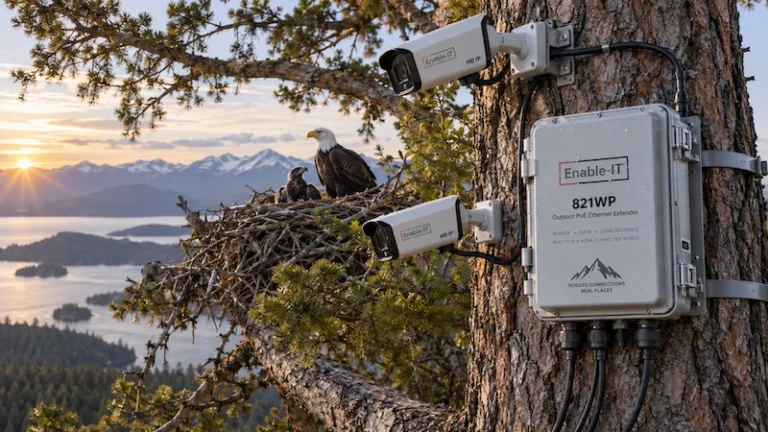
Enable-IT PoE Extenders deliver data and electrical power together over a single cable, pushing Power over Ethernet up to 4,000 feet and secure Ethernet up to 9,000 feet (2,743 m), over virtually any wire, including coax and existing copper. That changes everything about a wildlife camera deployment.
Keep the equipment far from the nest
The switch, power source, recorder, and uplink can live in a ranger station, a visitor center, or a weatherproof cabinet well outside the nest buffer. Only the camera and one cable go up the tree. Your team services the electronics without ever approaching the birds.
No outlets, no electricians, no trenching
Power rides down the same cable as the video. Whether the source is a building, a solar-and-battery station, or a PoE switch in a remote shed, there’s no need to run AC service into the habitat.
Power for the hard months, not just the easy ones
Here’s what many first-time nest cam projects miss: bald eagles nest in the dead of winter. A PTZ camera with infrared night vision and a housing heater draws far more power on a freezing February night than on a mild afternoon. Enable-IT PoE Extenders like the 821P (up to 71W) and the 865Q PRO (up to 150W) are sized for peak demand, so the camera stays warm, the IR stays on, and the stream stays live through the storms that matter most. (Our guide to PoE power budgets explains why peak power, not average power, decides whether a camera survives the winter.)
Built for the outdoors
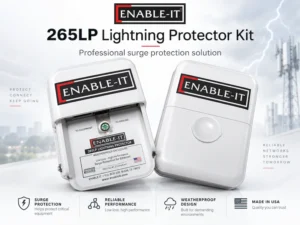
Enable-IT’s professional-grade outdoor extenders are engineered for extreme temperatures, rain, snow, and ice. And because the tallest tree in the forest is also the favorite target for lightning, our 265LP Gigabit PoE Lightning Protection Kit helps protect the camera, the cable, and the network gear back at the base.
Plug and go, then leave it alone
No configuration, no firmware, no programming. Install it in the off-season, confirm the picture, and step away. A system that doesn’t need attention is a system that doesn’t disturb the nest.
Secure streams
Communication between Enable-IT extender devices is encrypted. For protected species, nest locations are sensitive information, and a secure link helps keep your feed and your site under your control.
Pick Your Location: Tree, River, Aquarium, or Undersea
Eagle nests are where most people discover wildlife cameras, but the same approach works wherever living things go about their lives on their own terms.
- Treetop nests: Bald and golden eagles, ospreys, hawks, and owls, streamed in HD from cameras powered hundreds or thousands of feet from the nearest building.
- Cliffs and canyons: Condor and falcon nest sites in rugged terrain where running power is out of the question.
- Rivers and wetlands: Salmon runs, beaver lodges, waterfowl, and feeding grounds, monitored from a quiet distance along the bank.
- Aquariums: Exhibit, behind-the-scenes, and research cameras extended across large facilities over existing wiring, without tearing into walls or tank structures.
- Undersea and marine sites: Reef, kelp forest, and harbor cameras where long cable runs and harsh salt environments are the norm. Enable-IT has solved marine networking problems others called impossible, including the world’s first single-wire PoE Extender for autonomous ocean vehicles.
Trusted by the People Who Protect Wildlife
Enable-IT PoE Extenders and PoE switches have powered bird and wildlife watching projects at remote locations where AC outlets don’t exist, fiber is too fragile, and intrusive wiring would interfere with the mission. We are proud to support organizations like the American Eagle Foundation, the US Fish and Wildlife Service, the National Eagle Center, the Ventana Wildlife Society, the Cornell Lab of Ornithology, and aquariums worldwide.
These organizations share our belief that the best way to protect wildlife is to help people fall in love with it, and that the technology making that possible should never get in the animals’ way.
Why Wildlife Organizations Choose Enable-IT
Designed and Made in the USA in our AS9100D aerospace-certified facility. Professional grade equipment with trusted reliability in the harshest outdoor conditions.
An industry-leading Lifetime Product Warranty and a 45-Day Money Back Guarantee. Certified Spyware Free. No configuration: plug and go with the highest throughput. Same-day discounted shipping direct from our US factory floor. Next Business Day Advanced Replacement, because nesting season doesn’t wait.
A US-based expert technical support team that will help you plan the installation before you ever climb the tree. And Custom USA-made OEM solutions when your site needs something no catalog anticipates.
Bring the Wild to the World, Without Disturbing It
Pick a tree, a river, an aquarium, or a spot beneath the waves where you want to watch wildlife live their lives. We’ll help you get power and HD video there quietly, reliably, and from a respectful distance.
Planning a nest cam for next season? The best time to design it is now, before the birds return.