
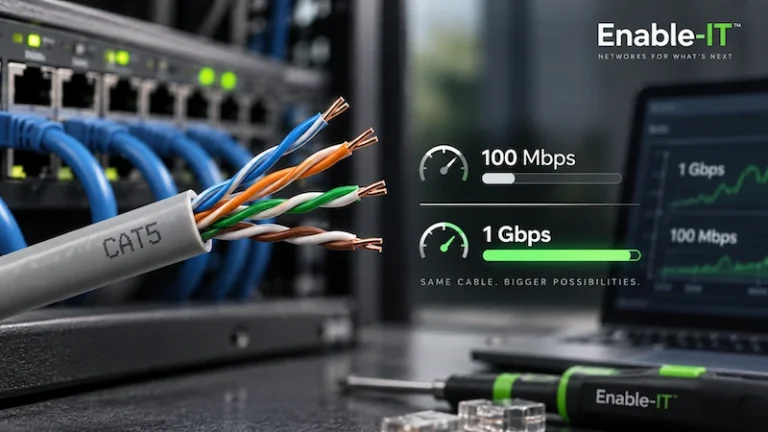
Category 5 Cable Speed
Category 5 cable speed is 100 Mbps (Fast Ethernet) with 100 MHz bandwidth over a maximum of 100 meters. The enhanced Cat5e standard raises this to 1,000 Mbps (1 Gbps) over the same distance.
When it comes to networking, Cat5 cable speed is one of the most discussed topics in both home and business IT setups. Despite being considered an older standard today, Category 5 cables (Cat 5 and Cat 5e) remain widely used because of their reliability, affordability and proven performance. In this article, we’ll uncover everything you need to know about this cable speed, how it compares with cat 5e speed, Cat 5 speed advantages, uses, future perspectives and some surprising facts along the way.
What Is Category 5 Cable?
Category 5 cable (Cat5) is a type of twisted-pair Ethernet cable that became the global standard for computer networking in the late 1990s and early 2000s. Before the arrival of Cat5, most local area networks (LANs) were limited to slower coaxial or earlier twisted-pair cabling. Cat5 and Cat 5 dramatically changed that by enabling faster, more reliable data transmission at an affordable price.
Category 5 Cable Speed Comparison: Cat5 vs Cat5e vs Cat6
| Specification | Category 5 (Cat5) | Category 5e (Cat5e) | Category 6 (Cat6) |
|---|---|---|---|
| Max Speed | 100 Mbps | 1 Gbps (1,000 Mbps) | 10 Gbps (up to 55 m) |
| Bandwidth | 100 MHz | 100 MHz | 250 MHz |
| Max Distance | 100 m / 328 ft | 100 m / 328 ft | 100 m (55 m at 10G) |
| PoE Support | Yes | Yes (PoE / PoE+) | Yes (PoE++ capable) |
| Status Today | Deprecated by TIA | Current minimum standard | Recommended for new installs |
| Extend Beyond 328 ft | All three can reach up to 9,000 ft with an Enable-IT Ethernet Extender | ||
📡 Technical Overview
- Category: 5 (defined by the TIA/EIA-568 standard as Cat5, Cat 5, Cat5e).
- Maximum speed (Cat5 speed): 10/100 Mbps (10BASE-T and 100BASE-TX Fast Ethernet).
- Bandwidth: 100 MHz.
- Maximum cable length: 100 meters (328 feet) per Ethernet segment.
- Wire pairs: 4 twisted pairs of copper wire (8 conductors in total).
- Shielding: Typically unshielded (UTP), though shielded versions (STP) exist for noisy environments.
The twisted-pair design is critical: each pair of wires is twisted at specific intervals to reduce electromagnetic interference (EMI) and “crosstalk” (signal bleeding between wires). This design helped Cat5 deliver clean, stable connections that were a massive leap forward compared to older technologies.
💡 Why Was Cat5 or Cat 5 So Important?
- Standardization of Ethernet – Cat5 unified the way homes and businesses wired their networks, making setup much simpler and more consistent.
- Cost-effectiveness – Copper twisted pair was cheaper and easier to install than coaxial alternatives.
- Scalability – It could handle both data (internet) and voice (telephone) connections, which made it very attractive for businesses.
- Backbone of the early Internet – Much of the internet boom of the late 1990s and early 2000s ran on Cat5 cables.
🏠 Where Cat5 Was Commonly Used
- Homes: Connecting PCs, routers, and early broadband modems.
- Offices: Structured cabling for LANs, VoIP phones, and printers.
- Education: Schools and universities used Cat5 to build out large-scale networks.
- Telephony: Cat5 often doubled as cabling for traditional phone systems.
🔄 Transition to Cat5e
By the early 2000s, the need for faster speeds (Gigabit Ethernet) revealed Cat5’s limits. This led to the release of Cat5e (Enhanced Category 5), which maintained the same physical design but improved internal wiring standards to reduce interference. While Cat5 maxed out at 100 Mbps, Cat5e boosted the ceiling to 1,000 Mbps (1 Gbps) without increasing cost significantly.
👉 In today’s world, Cat5 and Cat 5 are considered obsolete, and Cat5e has effectively replaced it. However, many networks still have Cat5 cabling installed – and it often works flawlessly for everyday use like browsing, streaming and email.

What is Cat5e and How is it Different?
As network demands grew in the early 2000s, Category 5e (Cat5e) – short for Enhanced Category 5 – was introduced as a significant upgrade to the original Cat5 standard. While Cat5 had served homes and businesses well, it was quickly reaching its limits with the rise of faster internet services, multimedia streaming, and the introduction of Gigabit Ethernet. Cat5e became the natural evolution, offering better performance while keeping costs low.
📡 Technical Specifications
- Category: 5e (defined in the TIA/EIA-568-B standard).
- Maximum speed (Cat5e speed): 1 Gbps (Gigabit Ethernet, 1000BASE-T).
- Bandwidth: 100 MHz (same frequency as Cat5, but with better data handling).
- Maximum cable length: 100 meters (328 feet) per Ethernet segment.
- Wire pairs: 4 twisted pairs of copper wire (just like Cat5).
- Shielding: Typically unshielded (UTP), but shielded versions exist for high-interference areas.
🔑 Key Differences Between Cat5 and Cat5e
- Speed Upgrade – While Cat5 speed maxes out at 100 Mbps, Cat5e speed supports up to 1,000 Mbps (1 Gbps). That’s a 10x performance increase.
- Reduced Crosstalk – Cat5e follows stricter standards to minimize “crosstalk,” or interference between internal wires. This means cleaner, more stable signals.
- Improved Data Integrity – Better testing requirements ensure fewer transmission errors.
- Backwards Compatibility – Cat5e can be used anywhere Cat5 was used, making upgrades simple without replacing all equipment.
👉 In short: Cat5 = Fast Ethernet (100 Mbps).
👉 Cat5e = Gigabit Ethernet (1,000 Mbps).
🏆 Advantages of Cat5e
- Future-proofing (for its time): Cat5e was designed to handle Gigabit speeds, which became the new standard in the 2000s.
- Affordable performance: It provided a massive speed increase without significantly raising installation costs.
- Wide adoption: Cat5e quickly replaced Cat5 in homes, schools, and offices – and still makes up a huge portion of existing cabling today.
- Supports PoE: Like Cat5, Cat5e can deliver Power over Ethernet (PoE) to devices like IP cameras, Wi-Fi access points, and VoIP phones.
🏠 Where Cat5e is Commonly Used
Even now, Cat5e is everywhere:
- Residential networks: Streaming movies, online gaming, smart TVs, and video conferencing.
- Small & medium businesses: Office LANs, VoIP telephony, printers, and cloud-based applications.
- Surveillance & IoT: IP security cameras, smart building devices, and access control systems.
- Education & healthcare: Schools, labs, and hospitals with high device density but moderate bandwidth needs.
🔮 Longevity and Future Relevance
Despite being over 20 years old, Cat5e remains relevant today. Many internet providers still offer speeds under 1 Gbps, which means Cat5e fully supports them. For households and small businesses, it’s often more than enough.
That said, with the growing availability of multi-gigabit internet (2.5G, 5G, and 10G Ethernet), newer cable types like Cat6, Cat6a, and Cat7 are becoming more attractive. Still, Cat5e will likely continue serving millions of networks for years to come thanks to its affordability and widespread presence.

Where Are Cat5 and Cat5e Still Used?
Although newer standards like Cat6, Cat6a, and Cat7 have entered the scene, Cat5 and especially Cat5e are still widely deployed in both residential and commercial networks. Their affordability, proven reliability, and compatibility with older devices ensure they remain part of the global networking landscape.
🏠 Home Networks
- Internet Browsing & Streaming – For households with internet speeds under 1 Gbps, Cat5e speed is more than enough for Netflix, YouTube and 4K video streaming.
- Gaming Consoles 🎮 – Xbox, PlayStation, and PC gamers often rely on Cat5e for stable, low-latency wired connections.
- Smart TVs & Media Centers 📺 – Many homeowners still use Cat5e cabling behind entertainment systems for direct, stable connections.
- Home Offices 🖥️ – With remote work on the rise, Cat5e provides reliable connectivity for video calls, file transfers and cloud apps.
🏢 Small & Medium Businesses
- LAN Networks – Many small offices run on Cat5e because 1 Gbps speed covers email, cloud services, VoIP, and shared printers with no issues.
- VoIP Telephony ☎️ – Cat5e is often used to power IP phones via Power over Ethernet (PoE).
- IP Cameras & Security Systems 🔐 – Cat5e provides both power and data to surveillance systems, making it cost-effective for building security.
- Point of Sale (POS) Systems 💳 – Retailers often use Cat5e for reliable cash register and credit card terminal connections.
🏫 Education & Public Institutions
- Schools & Universities 🎓 – Many educational facilities built networks with Cat5e in the 2000s and those systems still operate effectively.
- Libraries & Labs 📚 – Wired Cat5e connections provide stable, interference-free internet access for dozens of simultaneous users.
🏭 Industrial & Infrastructure
- IoT & Smart Devices – Cat5e supports IoT sensors, controllers, and smart-building technologies.
- Manufacturing Facilities ⚙️ – In controlled environments where data rates don’t exceed 1 Gbps, Cat5e remains a cost-efficient choice.
- Legacy Installations – Many factories and warehouses rely on older Cat5 wiring, which continues to serve well for basic communication.
📡 Telecommunications & Utilities
- Telephone Systems – Cat5 (and later Cat5e) was widely used to replace older copper lines in business phone setups.
- Utility Monitoring ⚡ – Energy and water companies use Cat5e in monitoring stations where extreme bandwidth is not required.
✅ Why They’re Still Used Today
- Cost-Effective – Cat5e is cheaper than Cat6 or Cat7, making it attractive for budget-conscious projects.
- Sufficient Performance – Since most ISPs still provide speeds under 1 Gbps, Cat5e can fully handle those speeds.
- Widespread Availability – Cat5e cables are everywhere, making replacements and installations easy.
- Reliability – Even older Cat5 runs can last decades if properly installed and maintained.
👉 In summary: Cat5 is gradually disappearing, but Cat5e is still the backbone of countless home and office networks worldwide.

Future Perspectives: Is Cat5 Still Relevant?
Technology moves fast – and so does networking. With the rise of fiber-optic internet, multi-gigabit Ethernet, and 5G connectivity, many people wonder: Does Cat5 still have a place in modern networks? The short answer is: Cat5 and Cat 5 are obsolete, but Cat5e is still relevant. Let’s break it down.
🛑 The Decline of Cat5
- Speed Limitation – Cat5 cable speed maxes out at 100 Mbps, which is far below today’s standard home internet speeds. Many ISPs now deliver 200 Mbps, 500 Mbps, or even 1 Gbps to residential customers.
- No Gigabit Support – With modern devices expecting Gigabit Ethernet ports, Cat5 cannot keep up. It acts as a bottleneck in otherwise fast networks.
- Phased Out Production – Most cable manufacturers no longer produce Cat5; Cat5e has fully replaced it in the market.
👉 Bottom line: Cat5 is fine for very old setups or low-bandwidth uses (like basic VoIP or connecting a printer), but it is not a good choice for new installations.
✅ The Staying Power of Cat5e
Cat5e, however, continues to shine. It supports 1 Gbps speed over 100 meters, which covers the vast majority of today’s networking needs.
- Internet Provider Speeds – Most home internet plans worldwide are still under 1 Gbps, which means Cat5e can handle them with no problem.
- Cost-Effectiveness – Upgrading to Cat6 or Cat7 is more expensive, while Cat5e remains affordable and reliable.
- Backward Compatibility – Works seamlessly with older equipment, making it a safe middle ground for upgrades.
- PoE Support – Cat5e is perfectly capable of delivering Power over Ethernet (PoE) for IP cameras, access points and VoIP phones.
🚀 When Should You Upgrade?
While Cat5e is still relevant today, certain situations call for newer cabling:
- Multi-Gigabit Networks – If you’re planning to run 2.5G, 5G, or 10G Ethernet, Cat5e won’t cut it – Cat6 or Cat6a is recommended.
- High-Performance Workplaces – Media companies, design studios and data centers often need faster transfer speeds.
- Future-Proofing – If you’re installing new cabling today and expect to keep it for 10–20 years, Cat6 or Cat6a is the smarter long-term choice.
- Very Long Runs – For distances beyond 100 meters, you’ll need extenders or fiber, as Cat5e has physical limitations.
🌍 The Big Picture
- Cat5 = Obsolete. It served its purpose but cannot handle modern internet speeds.
- Cat5e = Still highly relevant, especially for homes and small businesses.
- Cat6 and beyond = The future for high-bandwidth, multi-gigabit networking.
👉 In practical terms: If you already have Cat5e installed, there’s no urgent need to rip it out – it will likely serve you well for years. But if you’re wiring a new installation today, it’s worth considering Cat6 or Cat6a to avoid upgrades down the road.

Some Facts About Cat5 Cable Speed & Cat5e
Even though they might seem like “just cables,” Cat5 and Cat5e have a fascinating history and some unique qualities that have helped them remain important in networking for decades. Here are some interesting facts you might not know:
1. They Revolutionized Networking 🌐
Before Cat5, many networks used coaxial cables, which were bulky, harder to install, and less efficient. The arrival of Category 5 cable speed (100 Mbps) allowed Ethernet to become the universal standard for both homes and businesses.
2. Cat5e Made Gigabit Internet Affordable ⚡
When Cat5e speed (1,000 Mbps) was introduced, it brought Gigabit Ethernet to the mainstream without requiring expensive fiber-optic cabling. This jump made fast internet accessible to millions of homes and offices worldwide.
3. PoE Magic 🔌
Both Cat5 and Cat5e can transmit not only data but also electrical power through the same cable using Power over Ethernet (PoE). This means you can power devices like:
- IP security cameras 🎥
- Wi-Fi access points 📡
- VoIP phones ☎️
- Smart lighting 💡
…all without running a separate power cable.
4. The Twist that Changed Everything 🔄
The “twisted pairs” inside Cat5 and Cat5e cables aren’t just for looks. Each pair is twisted at a specific rate to cancel out interference and improve signal quality. Without this design, Ethernet would not be nearly as fast or reliable.
5. Still in Service After 20+ Years ⏳
Many Cat5 cables installed in the late 1990s are still working today. With proper installation and care, these cables can last decades – a testament to their durability and build quality.
6. A Rainbow of Options 🌈
Cat5 and Cat5e cables come in multiple colors (blue, yellow, red, green, black, white). While the color doesn’t affect performance, it makes network management and labeling easier – especially in large office networks or server rooms.
7. Cat5 is Officially Retired 🛑
The TIA (Telecommunications Industry Association) has deprecated Cat5 as a standard, meaning it’s no longer recommended for new installations. Cat5e has taken its place as the “minimum standard” for Ethernet cabling.
8. Cat5e Can Handle More Than You Think 💪
Even though Cat5e is “only” rated for 1 Gbps, many real-world tests show that under ideal conditions, it can sometimes handle 2.5G and even 5G Ethernet over shorter distances. (Though Cat6 is the safer choice for that.)
9. The Global Workhorse 🌍
It’s estimated that billions of meters of Cat5e cable are still installed worldwide, making it the most common Ethernet cable on the planet today.
10. Low-Tech but High Impact 💡
Unlike wireless technology that changes every few years, Cat5e has remained stable for over two decades. Sometimes, the simplest solutions stand the test of time.
👉 Fun takeaway: While Cat5 may be a thing of the past, Cat5e is the unsung hero of the internet era, powering everything from Netflix binges to office phone calls – and it’s still going strong.

Category 5 Cable Speed — Frequently Asked Questions
What is the speed of a Category 5 cable?
Category 5 cable speed is 100 Mbps (Fast Ethernet) with 100 MHz of bandwidth over a maximum distance of 100 meters (328 feet). The enhanced Cat5e revision supports 1,000 Mbps (1 Gbps) over the same distance.
Is Category 5 cable good enough for Gigabit internet?
Original Category 5 is not — it tops out at 100 Mbps. However, Category 5e (Cat5e) fully supports Gigabit Ethernet (1 Gbps) and handles the internet plans used in most homes and small businesses today. If your cable jacket says “Cat5e,” you’re Gigabit-ready.
What is the difference between Category 5 and Category 5e speed?
Category 5 supports 100 Mbps while Category 5e supports 1,000 Mbps — a 10x increase. Both use the same 100 MHz bandwidth and 100-meter distance limit, but Cat5e meets stricter crosstalk standards that make Gigabit speeds reliable.
How far can Category 5 cable run without losing speed?
The IEEE 802.3 standard limits Category 5 and Cat5e to 100 meters (328 feet) per segment. Beyond that, the signal degrades. To go further, an Ethernet Extender can carry the connection up to 9,000 feet (2.74 km) over a single wire pair — 27 times the standard limit.
Final Thoughts and Conclusion
Cat5 and Cat5e cables have played a massive role in shaping modern networking. While Cat5 cable speed (100 Mbps) has become outdated, it was once the backbone of the early internet era. Its successor, Cat5e speed (1,000 Mbps), remains one of the most widely used Ethernet standards in the world, providing a balance of affordability, reliability and performance.
For most homes and small businesses, Category 5e speed is still more than enough to handle streaming, video conferencing, online gaming, smart devices, and everyday office workloads. It also supports Power over Ethernet (PoE), making it useful for powering cameras, phones, and Wi-Fi access points without extra wiring.
However, as multi-gigabit internet and high-performance applications become more common, Cat6 and Cat6a are quickly emerging as the future-proof choice. Cat5 is already obsolete, and Cat5e will eventually follow the same path as technology continues to evolve.
👉 The key takeaway:
- If you already have Cat5e installed, you’re covered for now.
- If you’re building new networks or planning for the next decade, consider Cat6 or higher.
At Enable-IT, we help extend the life and performance of Cat5 and Cat5e installations with Ethernet and PoE extenders, allowing your existing infrastructure to go further than ever before. Whether you’re working in a home, office, industrial site, or even critical infrastructure, we make sure your cabling investment keeps delivering.
🚀 In a world racing toward faster connectivity, Cat5e still holds its ground – proving that sometimes, the classics never truly go out of style.

Extend any Ethernet Cable Beyond the Limits with Enable-IT Solutions !
The benefit of buying an Ethernet Extender from Enable-IT because our equipment leverages high throughput telecom signals over any wire – including coax, barbed wire fence, etc. Enabling distances unheard of in the industry. There are Ethernet Extender Solutions available that can extend this distance limit out to 9,000 feet or 2,743 m.
The industry uses are endless – as everyone has a need for extended Ethernet many times in their lifetime and sooner than later the need will arise and we are ready when you are to help select a solution.
Diverse Industry customers include the US, UK and Canadian Military; NASA; Aerospace manufacturers; Nautical Infrastructure (Marinas, Mega Yachts, Cruise Ships,Port facilities, US Nuke sub fleet, etc); Video Surveillance and Security Specialists; Advanced Telecommunications companies; Extreme Mining Operators; Global Construction Enterprises; Commercial Agriculture companies; major Healthcare providers; Live Entertainment, Broadcasting, and News agencies; Extreme Retail/POS organizations; Long-Distance Education Companies; International Hospitality Companies; Elevator manufacturers, Digital Signage and much more.




 English
  Español de Colombia
  Português do Brasil