


Ethernet Explained: Cable Types, Distance Limits & Extenders.
Cable categories, the 328 ft limit and how to beat it over coax, powerline or old copper, from the USA engineers who build Ethernet extenders



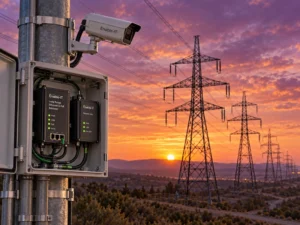

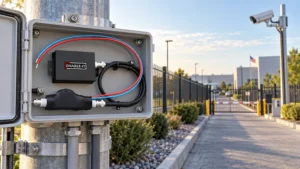
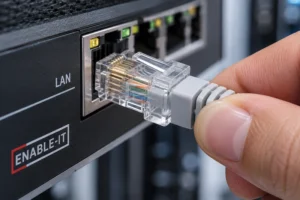
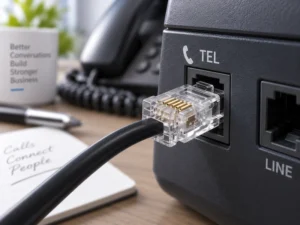


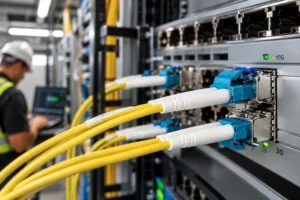

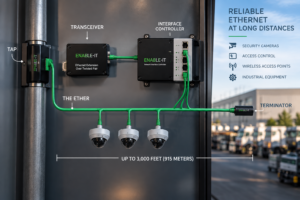
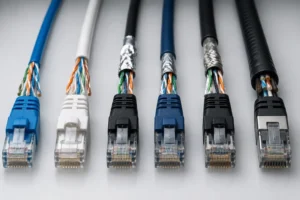


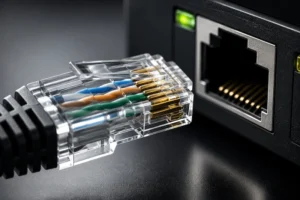






Ethernet is the wired language of almost every network on Earth. It was developed under Robert Metcalfe at Xerox PARC in 1973, and it has grown from thick 900-foot coax into the twisted-pair cabling that connects offices, factories, data centers and homes today. Enable-IT has spent decades engineering ways to push Ethernet farther than the standard allows. This guide collects what we’ve learned. Start with what is Ethernet and the history of who invented Ethernet.
The cable you choose sets your speed ceiling. Cat5 tops out at 100 Mbps, and Cat5e raises that to 1 Gbps over the same 100 meters. Cat6 supports 10 Gbps, but only up to about 55 meters. Compare the categories in Ethernet cable types explained and Cat5 and Cat5e cable speed. Wire thickness matters as well: lower-gauge copper such as 22 or 24 AWG has less resistance and carries signals farther, as covered in wire gauge for communications and PoE. For short, high-speed links between switches, multimode fiber types OM1 through OM5 each have their own distance limits. Even the connector counts: many “mystery” network problems trace back to a bad crimp that still passes a basic test, which is why we explain recrimping RJ-45 heads and the RJ11 vs RJ12 modular plug.
Every twisted-pair Ethernet standard caps a single cable run at 100 meters (328 feet). Past that point, resistance and interference weaken the signal until speed drops, latency climbs and the link fails. Find out how long an Ethernet cable can be and why a longer cable alone won’t fix it. Wired connections still beat Wi-Fi for stable, low-latency traffic, which is why serious gamers switch to Ethernet.
Couplers, switches, media converters and fiber each have a place. Our guide on how to extend your Ethernet cable compares them. An Ethernet Extender takes a different approach: it converts Ethernet into a telecom-grade signal that travels up to 9,000 feet (2,743 m) over a single pair of almost any copper wire. Learn how Ethernet extenders work, how to daisy-chain extenders for even longer runs, and how to get the best throughput from each link.
The best network cable is often already in the wall. Historic buildings, campuses and plants are full of telephone pairs, coax and control cable that can carry modern Ethernet, and our extenders can add PoE over that same legacy copper. Read leverage old wire for high-speed LAN, Ethernet over coax adapters, powerline Ethernet extenders and gigabit Ethernet over high-voltage DC coax. Connecting a garage, barn or remote building? See how to run internet to an outbuilding.
When OTIS Elevator’s only supplier stopped making the VDSL2 SFP modules that connect its elevators worldwide, Enable-IT delivered a drop-in G.hn replacement that fit OTIS’s existing SFP chassis and ran over its existing copper. Read the OTIS supply chain rescue and meet the SFP copper G.hn module, which carries gigabit Ethernet up to 3,000 feet over one copper pair. At NYSE Euronext, where network latency is measured in nanoseconds, Enable-IT extenders helped connect a growing data center network. Read the NYSE Euronext case study.
Need to plan a run? Try our Extender Distance and PoE Planner, or talk to an Enable-IT engineer.
We Are More Than Happy to Listen To Your Specific Project Needs.
Enable-IT Guarantees Your e-Mail Privacy 100%
Your Information Is Never Shared Or Sold.